AI-Generated Product Videos vs. Studio Shots: What Buyers Actually Notice
AI video grew up in 2026 — for lifestyle context and hero frames it is barely distinguishable anymore. But on hands touching products, packaging text and logo consistency it falls apart. Where AI really works, where studio stays, and why hybrid is the honest answer.

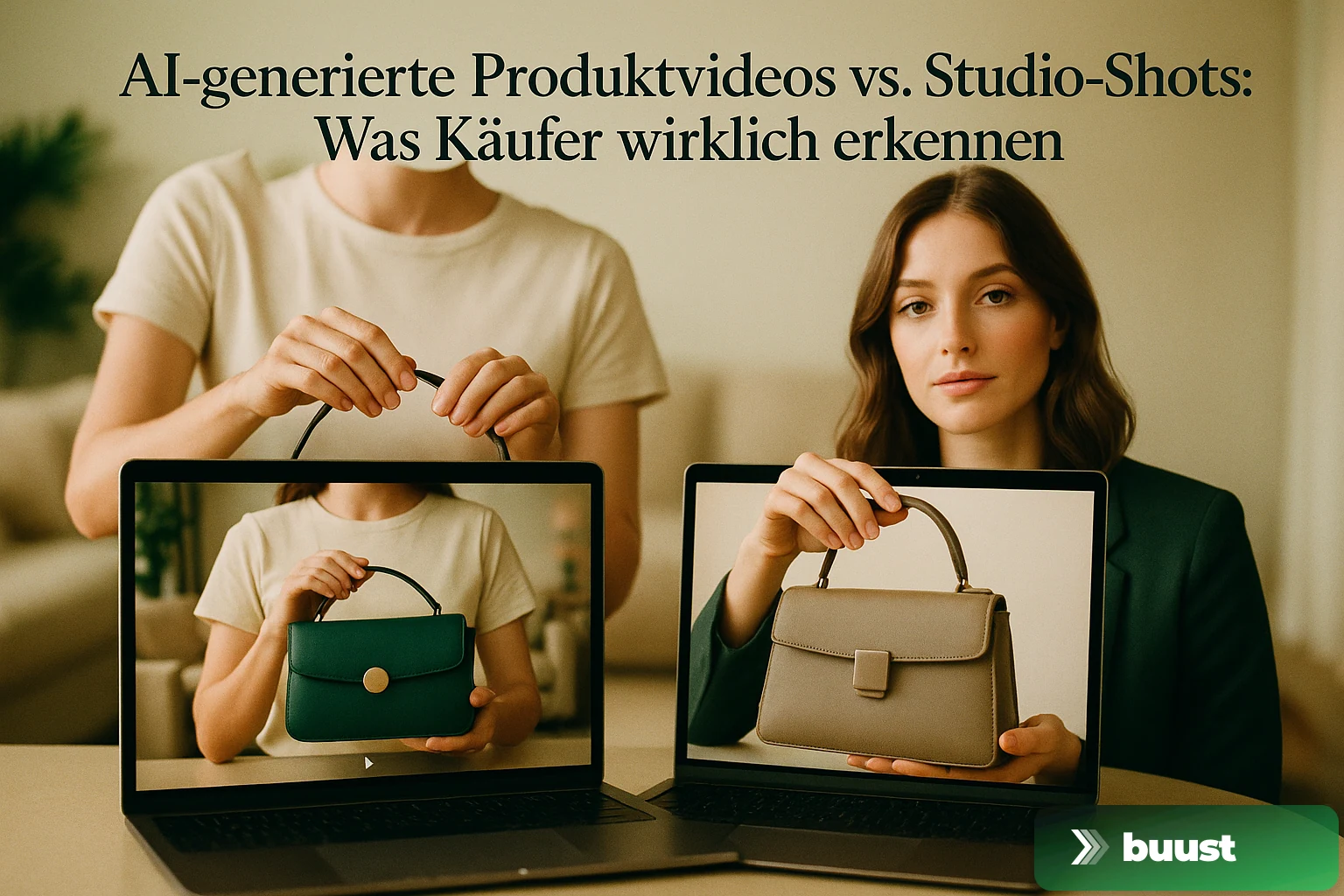
For a long time you had to smile at AI-generated product videos. Hands with seven fingers, logos dancing around the frame, packaging text that turned into alphabet soup after three seconds. Anyone trying to use AI video for their product in 2024 needed strong nerves and weak buyers.
2026 is a different world. Lifestyle scenes, hero frames, camera moves around static product photos — all of that is now at a level even trained eyes cannot immediately flag as AI. But not everything.
Where AI video really works in 2026
There are three use cases where AI is now production-ready.
Lifestyle context around the product
A sweater photographed on a sofa that never existed. A candle burning on a wooden table in an apartment that does not exist anywhere. A travel bag at an airport gate no one ever stood at. All of that works — because the buyer is not checking the setting. They check the product. As long as the product itself is correct, the context goes unnoticed.
This kind of imagery was always staged. Buyers do not expect the hotel room in the travel bag photo to be a real booking. AI lifestyle here is not a break from expectation — it is a cheaper version of the familiar.
Abstract hero frames
A close-up on a wool texture, light hitting glass, powder falling into a bowl. These shots exist for atmosphere and visual tension, not product information. They appear in the first one or two seconds of a video and are perfect for it — no details that can go wrong, no logos that need to stay still.
Motion around a static photo
This is maybe AI's strongest use case in ecommerce. You have a single, sharp product photo — and an AI model turns it into a camera move, a push-in, a parallax motion. The product stays unchanged (it is the real photo), but the video gains motion that the algorithm rewards and that stops the buyer's eye.
Here AI is not "instead of studio", it is "beyond studio": you have one studio shot and multiply its effect without re-shooting.
Where AI video falls apart in 2026
And then there are the areas where AI, even on top models, still visibly fails. Most of them come down to three categories.
Hands on the product
The moment a human hand needs to touch, hold, turn or operate the product, things get critical. Fingers twist, thumbs wander, hands take two different positions inside one second. Even the best 2026 models produce a visible anomaly in roughly every third take, and buyers register that subconsciously and instantly.
Fix: hands belong in the studio. No good workflow lets AI generate hands on a product — anything else is long-term trust damage.
Text and logos on packaging
An AI model sees "white packaging with a dark logo" — but it does not read your brand name, it guesses it. What lands on the packaging is, with high probability, a typeface that resembles your real logo but is not it. One letter shifted, one symbol changed, one color slightly off.
Buyers who know your brand spot that in seconds. Buyers who do not know your brand subconsciously walk away with the impression that "something feels off, this cannot be real".
Fix: packaging shots belong in the studio. Or: packaging as a real photo, and AI only outside the packaging area.
Logo consistency across multiple frames
When a logo runs through the video — on the product, on a bag, on a T-shirt — it has to look identical in every frame. AI models generate each frame with some variability, and logos are exactly the spot where this variability becomes visible. Over three seconds the logo "breathes", shifts by two pixels, suddenly has a different stroke weight.
Fix: logos get filmed in the studio or added afterwards as a static element. AI generates the environment, not the brand mark.
Where studio stays unbeatable
There are use cases where studio is not replaceable in the foreseeable future.
- Hyper-detail shots. For jewelry, watches, mechanics, gemstones, fabrics with high textural granularity — materials whose sales argument is in the detail — studio delivers a sharpness and authenticity AI does not produce
- Function demos. When the product has to be shown in real use (cooker cooks, drill drills, folding bike folds) — anywhere the buyer needs to know "does this really work" — studio is mandatory
- Brand moments. Packaging reveals, hands-on unboxing sequences, logo showcases with real staging. Trust matters here, and in 2026 trust is still carried by real footage, not synthetic
For all of that: studio stays — but studio no longer has to cover every single shot.
Why hybrid is the honest answer
Most sellers think in the wrong dimension. They ask: "Should I use AI or studio?" The right question is: "Which parts of my video have to be studio, which parts can be AI?"
A typical hybrid workflow looks like this:
- Studio shot of the product as the central asset (produced once per product, sharp, honest, accurate)
- AI lifestyle composition around the studio shot (different settings, moods, backgrounds, without re-shooting the product)
- AI motion on the studio shot to create camera moves without filming again
- Studio for hands, function, packaging reveal at exactly the spots where AI would fail
The result: one-time studio effort per product, after that unlimited video variants in different settings, moods and formats. Studio stays where it counts — AI multiplies where it is allowed to.
Cost-wise, this is the decisive difference. Pure studio production across 200 products is a four- to five-figure project. A hybrid workflow is a fraction of that, because the one-time studio asset is reused — across multiple settings, formats and moods.
Whoever has this under technical control, wins
Most sellers do not get far with hybrid because the technical bar is high. Composing an AI lifestyle frame around a product photo without the product morphing — today that is still a workflow with several tools, lots of trial and error, and brittle results.
That is exactly the leverage point of the next few years. Whoever has a system that automatically embeds studio assets into AI context — without the product changing, without logos wandering, without packaging text being hallucinated — produces hybrid videos in seconds instead of days.
At Buust we built this logic into the render workflow. You supply a product photo (or have it pulled from your shop/marketplace), pick a template, and the renderer automatically combines studio fidelity for the product with AI generation for lifestyle, hero frame and motion. The product stays unchanged. The context scales.
Start for free and see what a single studio photo looks like across ten different lifestyle settings. If you cannot see the difference to "classic AI video", you have lost nothing — if you can, you have understood a production logic that can shift your next two quarters.
Common questions on the topic
Can buyers really tell whether a video is AI-generated?+
On the classic weak spots, yes — twisted hands, floating logos, packaging text that morphs. On lifestyle context, abstract hero frames and motion around a static photo, almost never. The difference is not about the buyer, it is about the type of shot.
Do I lose trust if AI video is spotted in my listing?+
It depends. Buyers accept AI for lifestyle imagery and context shots because they understand those have always been staged. They react negatively when AI invents visible product details (wrong packaging, wrong logo, wrong function). Hybrid workflows protect against that risk.
What does a hybrid workflow cost compared to pure studio?+
Studio production typically costs between €200 and €2,000 per product. Hybrid workflows with AI lifestyle composition around real product photos cost a fraction of that, because the actual studio shoot is only required once per product. Across 200 products the difference is four to five figures.
When is studio absolutely irreplaceable?+
For hyper-detail shots (jewelry, mechanics, material texture), for function demos (the product in real use with real hands), for brand moments (packaging reveal, logo showcases). For all of that, AI in 2026 still does not deliver believable quality. For the rest, it does.
Ready to switch your listings to video?
10 videos free. No credit card. Connected in under 5 minutes.
Keep reading
EU AI Act from 2 August 2026: what the AI-labelling rule means for online sellers
From 2 August 2026 the transparency rules of the EU AI Act apply. Anyone using AI-generated product images or videos must label them as artificially created in a machine-readable way. What that means in practice, who it affects — and why no visible watermark is needed.
3D in the product listing: why spatial commerce isn't a gimmick in 2026
A rotatable 3D model on the product page used to be expensive, technical, and Shopify-only. That's changing — 3D and AR now land on Shopware too. What spatial commerce actually delivers, and who it's worth it for.

Your Visitors Think Your Shop Is Fake — and Buy on Amazon
They have interest, they have money, they want to buy — just not from you. Because in the first seconds your shop looks "too good to be true." In 2026 buyers are trained on fraud. Why plain photos now trigger distrust — and what brings trust back.