Bullet Points Are Dead: Why 5 Seconds of Video Sells More Than 5 Paragraphs of Text
Bullet points were made for sellers, not for buyers. Why 80 percent of the points in your product page are read by nobody — and what builds more trust in five seconds than three paragraphs of text.

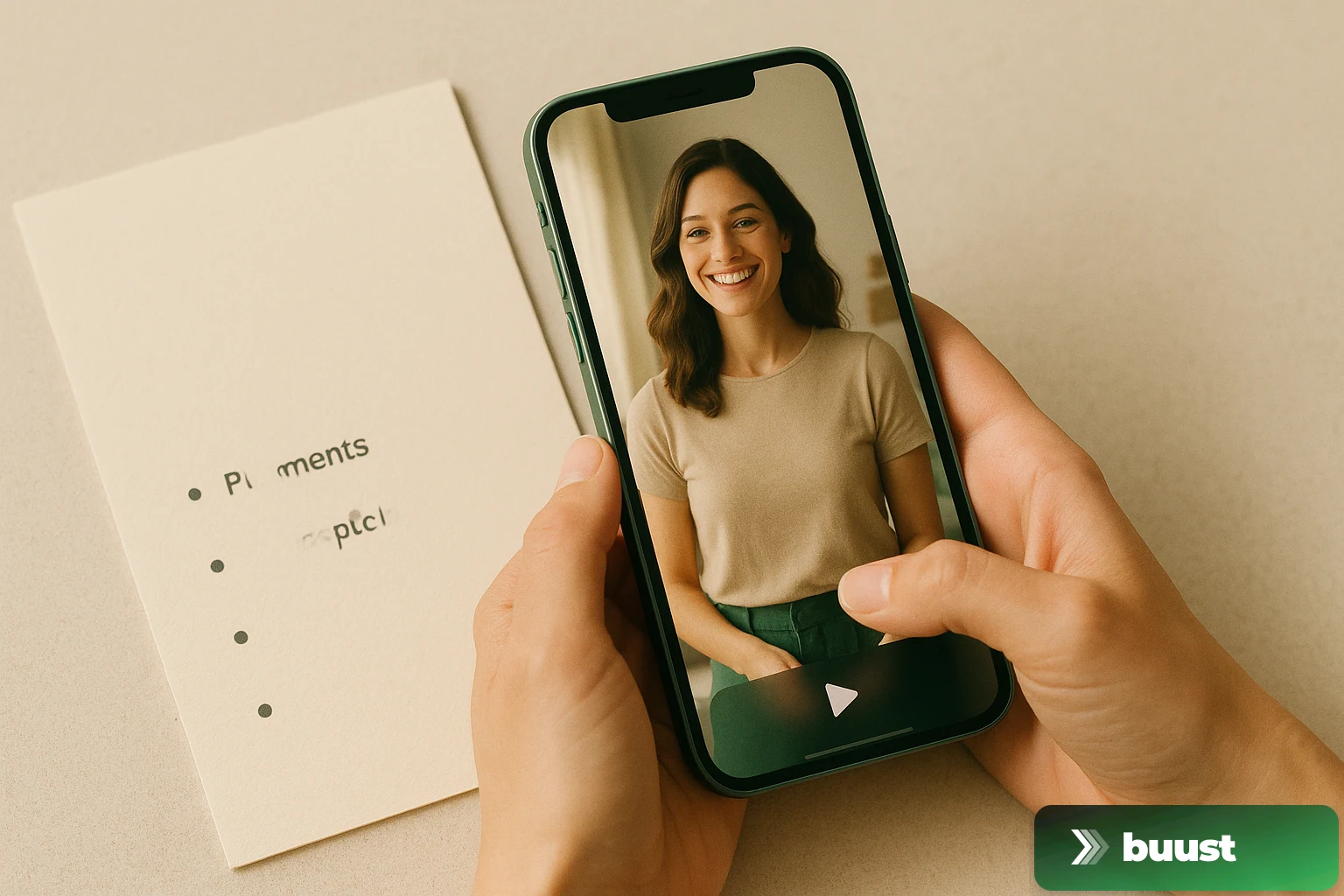
Bullet points are not dead because they are bad. They are dead because they were written for the wrong person.
Anyone who built product pages over the past ten years learned: make it scannable, break into chunks, lists instead of running text. That was a valuable step away from the operating-manual look of the early 2000s. But somewhere between the twentieth and the fiftieth product, it became a template — and today the template mostly helps the seller write, not the buyer decide.
Who the bullet list actually serves
Ask yourself honestly: when do you read bullet points all the way through? Probably exactly when you have almost decided and only want a fact check. Dimensions, material, quantities, compatibility. That is a narrow but important role.
What most bullet lists actually contain:
- "High-quality workmanship for a long lifetime"
- "Modern design for any occasion"
- "Optimally suited for daily use"
- "Premium quality at a fair price"
Four bullets, zero information. These bullets are the seller's answer to the question "what else should I write?". They are not the answer to a question the buyer asked.
Buyers want proof, not claim
This is the actual core. A bullet list is always a promise from the seller. "Waterproof." "Robust." "Quiet in operation." Those are statements the buyer either believes — or does not.
A video flips the burden of proof. "Quiet in operation" as a bullet you believe or you do not. "Quiet in operation" as a three-second recording with the device running next to a sleeping dog is not negotiable anymore. It is shown.
That is exactly the shift ecommerce has been going through these past two years. Buyers have been trained by Reels, TikTok, YouTube Shorts and influencer product tests to trust shown things more than described ones. Anyone trying to sell with adjectives in 2026 is selling to half the buyers they would have reached five years ago.
What 5 seconds of video do that 5 paragraphs of text cannot
A short, honest list — what video really does well, and what it does not:
- Convey scale — a hand next to the product says more about the size than any centimeter spec
- Show material — how it reflects light, how the fabric falls, what the surface looks like up close
- Suggest usage — one second of "product in hand" and the buyer has seen themselves using it
- Show speed — for devices, tools, anything with mechanics: a bullet claims, a video proves
- Provide context — the same product in the kitchen, in the bath, in the garden — three sequences, three use cases
What video does not replace:
- exact dimensions down to the millimeter
- compatibility lists ("fits the following models…")
- warranty and shipping info
- anything legally required
That is exactly the point: video does not replace the bullets that actually carry information. It replaces the bullets that carry mood — and mood is conveyed ten times more efficiently by moving image than by text.
The 80 percent rule
Do the following test with one of your product pages: print out the complete bullet list. Strike through anything that is a concrete, verifiable fact. What remains is the list the video absorbs.
In practice, for most listings three to five real facts remain — and six to fifteen advertising bullets no buyer needs. That is the 80 percent rule: four out of five bullets could go as soon as a good product video sits next to them. The page gets shorter, faster, more trustworthy. And the bullets that remain actually get read, because they are no longer drowning in a mess of ad copy.
When bullets win — and that is fine
There is a class of products where the bullet list remains the most important element of the product page even in 2026: B2B components, spare parts, specialty tools, anything where the buyer has a very specific question and decides very specifically.
Example: someone buying a filter for a specific machine does not want to be emotionally convinced. They want to know: does the thread fit? Which micron? Which brand is compatible? Here a video is at best a complement, not the main carrier. Three bullets can sell more in this world than three minutes of glossy camera flight.
But that is the special case. For the typical marketplace or shop seller with consumer goods, fashion, home, sport, hobby, decor, tools, electronics — so for 90 percent of all products sold — the rule holds: anyone who has video can cut bullets and still sells more.
What you could change today
You do not need a theme rebuild, no new strategy, no ten thousand euro ad budget. You need two things:
- A video on the product page that shows in the first three seconds what the product is and what it does
- An honest culling of your bullets — anything that only claims without informing goes
Step two costs nothing and is done in an hour. Step one is the actual lever. And step one is also what most sellers have been kicking down the road for years, because the idea of "filming 200 listings individually" is paralyzing.
With Buust you connect your shop or marketplace account, pull all products and generate videos from the existing images for your entire catalog. Embedded directly on the product pages and simultaneously published to your social channels. No film crew, no per-listing work.
Start for free and see what your three best-selling products look like with motion instead of a wall of bullets. You will be surprised how much text suddenly looks redundant.
Common questions on the topic
Have bullet points really become obsolete?+
Not all of them. Bullets that carry concrete facts — dimensions, material, compatibility, quantities — still get read when the buying decision is almost made. Bullets carrying ad clichés ("high-quality workmanship", "premium quality") get read by nobody. Roughly 80 percent fall into the second category.
When is a bullet list superior to a description?+
When the information needs to be comparable. Three bullets with dimensions are better than flowing text with dimensions, because the eye can scan them side by side. As soon as it is about properties like feel, application or effect, the human — and the moving image — wins against the list.
What does a video show that bullets cannot?+
Bullets claim. Video shows. "Waterproof" as a bullet is a statement by the seller. "Waterproof" as a sequence in the video where the product is held under the tap is proof. Buyers in 2026 distinguish very precisely between claim and proof.
Do I have to delete my bullets now if I have video?+
No. But cut them radically. Keep the three to five bullets that carry real facts, drop all the ad speak. The video takes over emotion and trust, the bullets take over the last facts right before the click on "Buy".
Ready to switch your listings to video?
10 videos free. No credit card. Connected in under 5 minutes.
Keep reading
Try it on right in your shop: how virtual try-ons cut returns
The most expensive return is the one that should never have happened — ordered "in two sizes to try". A virtual try-on answers the "does this suit me?" question before the purchase. Here's how try-on works in your own shop.
The Buust Score: how well does your listing actually sell — and what to do next
Most listings aren't bad — they're just weak in one spot, and nobody tells you which one. The Buust Score turns "optimize it somehow" into a single number and exactly one next step. Here's how to read it.

Seven Out of Ten Add to Cart — and Never Buy: Where Your Ready-to-Buy Visitors Disappear
They searched for your product, found it, added it to the cart — and vanished. These are not random visitors, these are your most ready-to-buy customers. Why they bail at the last moment — and how to kill the doubt before it kills the sale.