Discover-First Commerce: Why Google Discover Matters More Than Google News in 2026
Google Discover is the silent top-3 traffic channel most ecommerce brands have never heard of. High-quality images, editorial content, clear signals — and suddenly thousands of clicks flow in from a feed you do not even actively manage.

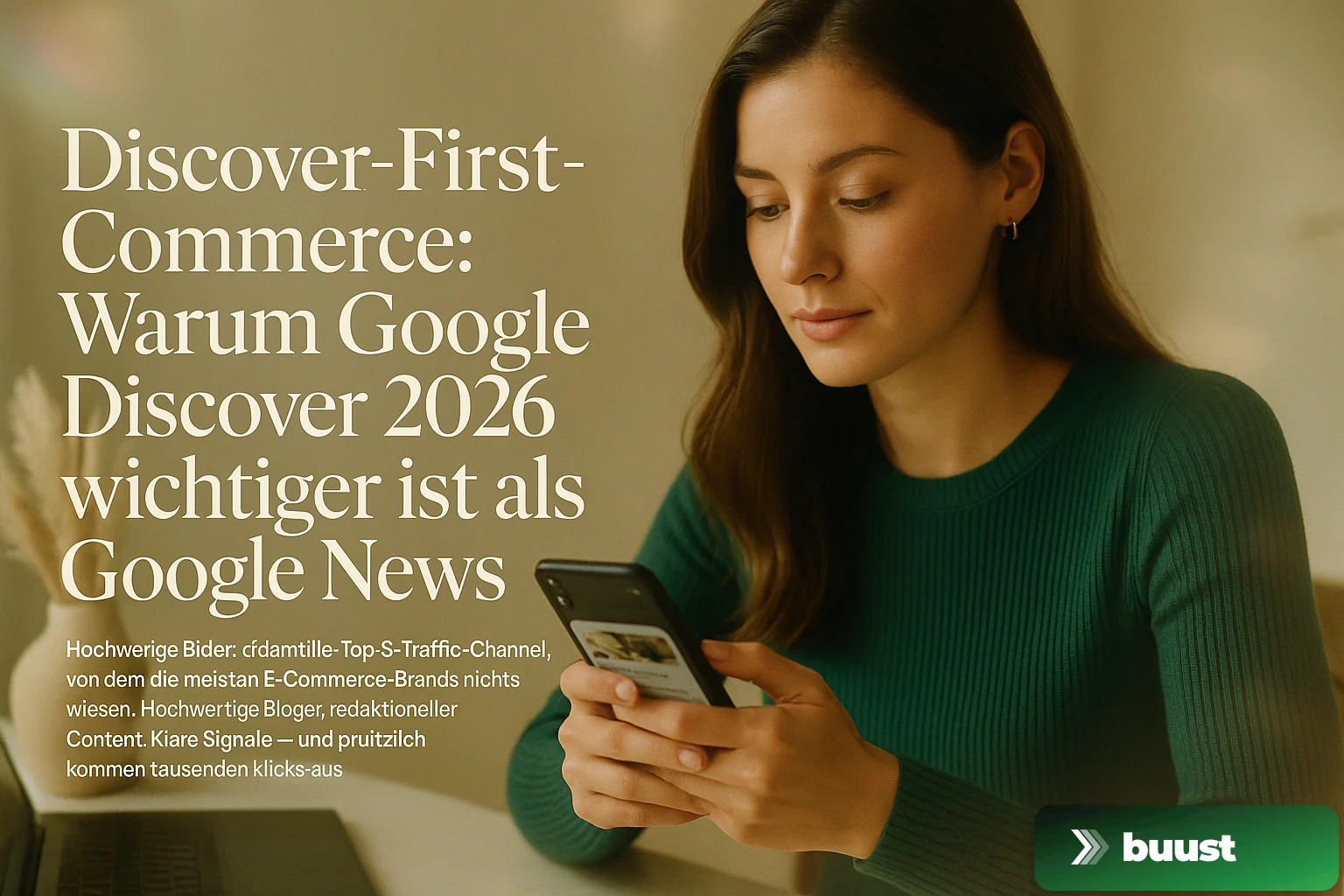
There is a traffic channel most ecommerce brands do not have on their radar in 2026 — and which has simultaneously become one of the largest organic growth levers for the ones who understand it. Its name is Google Discover. And it works on rules that have very little to do with classic SEO.
Anyone who swipes left-to-right on an Android phone or opens the Google app sees it every day: an endless feed of personalized articles and products, served by interest, with no one having searched anything. That is Discover. And that is where, in 2026, a large part of what used to be Google News now lives.
Why Discover overtook News
Google News was for years the place to be for publishers and brand blogs. Political daily news, sports, business — visibility there meant significant traffic. But News is narrow. It is tied to newsworthiness, recency, editorial standards.
Discover is more open. Discover serves a lifestyle magazine next to a recipe next to a product breakdown next to a travel report. It serves your blog post, if it sends the right signals. Even if it is not "news" — just good.
That has two consequences:
- More brands have access to this feed than to News. You do not have to be a publisher.
- Competitive pressure is structured differently. You are not competing with the major papers, you are competing with other brand magazines — most of them mediocre.
For ecommerce brands with a serious content hub, Discover in 2026 is what Pinterest was in 2018: an underestimated channel where early movers have not yet suffocated each other.
What gets into Discover in 2026
The structural requirements are clear, even though Google has never published an official list. What works:
- Hero images from 1200 pixels wide, the tag
max-image-preview:largein the meta block so Google is allowed to render the image large - Clear author and publication dates — Discover prefers content with tangible authorship, not anonymous brand text
- Editorial depth — guides, comparisons, experience reports, background pieces. Content that has a real point of view.
- E-E-A-T signals: Experience, Expertise, Authority, Trust. Concretely: authors with traceable profiles, sources cited, clear brand identity.
- Discover-ready structured data: Article schema, optionally NewsArticle where fitting, with correct datePublished and image references
- Mobile performance below 2.5 seconds Largest Contentful Paint — Discover is mobile-only, slow pages get throttled
Set these signals consistently and you earn your entry — even though there is no official sign-up.
What stays out
Equally clear is what Discover does not serve:
- Plain product detail pages without editorial context. A listing page with photo, price and description is not Discover-ready, no matter how pretty.
- Thin content under 500 words that feels like an SEO duty piece. Discover spots it and hides it.
- Pure sales copy without real value for the reader. If an article only exists to push a buy CTA, it does not get served.
- Content without strong visuals. Discover is a visual feed. Text without a worthy hero image gets no chance.
- Clickbait titles with "You won't believe what…" — Google has hard-calibrated its algorithms against Discover clickbait since 2023.
That is the uncomfortable news for most shop operators: your online shop alone cannot land in Discover. It needs a content layer. And that layer has to be good, not just present.
Why Discover is especially powerful for ecommerce
Here is the actual difference to classic SEO. In Discover you land before purchase intent. The user did not search for your product. They sat on the sofa, scrolled the feed and stumbled onto your guide — and onto your product inside it.
This position before purchase intent is gold, because:
- You are the first touchpoint in the buyer journey, not the second or third
- You have no direct competitive listing like on a search results page — the user is not immediately comparing you with three alternatives
- Branding and trust form before the price comparison, which makes later conversion more robust
- Loyalty effect: someone who knows you from Discover later searches actively for your brand — that is classic direct traffic growth
This is not theoretical. Ecommerce brands with an active content hub regularly report that Discover clicks have a lower direct conversion rate than Google search clicks — but a significantly higher return-visitor rate over 30 and 90 days.
A pragmatic checklist
If you want to build Discover traffic systematically, here are the five levers to start with:
- Establish a blog hub with at least one new article per week, categorized, with clear author pages
- Hero images consistently from 1200 pixels wide, in WebP, with meaningful alt text and max-image-preview:large set
- Article schema on every post including author, datePublished, image, publisher
- Measure and optimize mobile LCP — if your blog loads above 2.5 seconds on mobile, you have barely a chance in Discover
- Pick topics with editorial potential: guides, comparisons, trend analyses, insider knowledge. No plain product descriptions.
This checklist is not revolutionary, but it is the baseline. Without these five points, Discover is a closed channel for most brands.
How video fits into this story
Here is an often-overlooked connection. Discover prefers visually strong content — and articles with embedded video tend to gain more visibility than pure text pieces.
If your blog post on "The 5 best desk setups 2026" embeds a product video for your desk, you have two signals at once: editorial depth and visual strength. Discover loves it. Classic search results honor it too, but Discover turns it into disproportionate reach.
This is exactly where the content hub and product videos connect. Anyone already producing videos for their products has the building blocks for their editorial content essentially for free.
Where brands trip up in practice
The two most common mistakes:
- Discover is tried once and dropped, because traffic does not explode in week 1. Discover is a 6-to-12-month game. Anyone who publishes three articles and stops sees nothing.
- Content is produced as an SEO chore, not as a real editorial piece. Discover recognizes thin, AI-generated, viewpoint-free text — and hides it.
Both are fixable, but only with the willingness to treat content marketing not as a side activity.
The pragmatic path to Discover-ready visuals
With Buust you get not only product videos for listings, but also the hero visuals and short reels you can embed in your blog hub — at the right resolution, with the right mobile performance, in the formats Discover prefers. One video per product that then lives on the product page, on social and in your editorial content.
Start for free and see what your three best-selling products look like as Discover-ready editorial visuals — before you write the next blog post.
Common questions on the topic
What exactly is Google Discover?+
Discover is the personalized mobile feed that appears in the Google app and on Android home screens below the search bar. It shows articles, products and visuals based on a user's interests without them having searched. Effectively the "TikTok algorithm" for web content.
Can I actively influence whether my content lands in Discover?+
Not directly — there is no sign-up. But you can massively increase the probability by delivering the structural signals: max-image-preview large, high-resolution hero images from 1200 pixels wide, editorial content instead of plain product pages, clear author and publication dates.
Why are product pages alone not Discover-ready?+
Discover prefers content with editorial depth — blog articles, guides, comparisons, stories. Pure product detail pages without editorial context rarely get shown. Brands without a content hub have a hard time getting visible in Discover.
How much traffic does Discover realistically deliver?+
Very variable. Brands with consistent content output and high-quality visuals report Discover shares between 10 and 40 percent of their organic mobile traffic. A viral article can bring 50,000 to 200,000 clicks in 48 hours. But not plannable.
Ready to switch your listings to video?
10 videos free. No credit card. Connected in under 5 minutes.
Keep reading
EU AI Act from 2 August 2026: what the AI-labelling rule means for online sellers
From 2 August 2026 the transparency rules of the EU AI Act apply. Anyone using AI-generated product images or videos must label them as artificially created in a machine-readable way. What that means in practice, who it affects — and why no visible watermark is needed.
3D in the product listing: why spatial commerce isn't a gimmick in 2026
A rotatable 3D model on the product page used to be expensive, technical, and Shopify-only. That's changing — 3D and AR now land on Shopware too. What spatial commerce actually delivers, and who it's worth it for.

Your Visitors Think Your Shop Is Fake — and Buy on Amazon
They have interest, they have money, they want to buy — just not from you. Because in the first seconds your shop looks "too good to be true." In 2026 buyers are trained on fraud. Why plain photos now trigger distrust — and what brings trust back.