The 3-Second Formula: Headline, Hook and Cut for Better Product Videos
The first three seconds decide whether someone keeps watching or keeps scrolling. Here's the concrete second-by-second formula that turns an interchangeable product video into an actual selling machine — with examples of good and bad hooks.

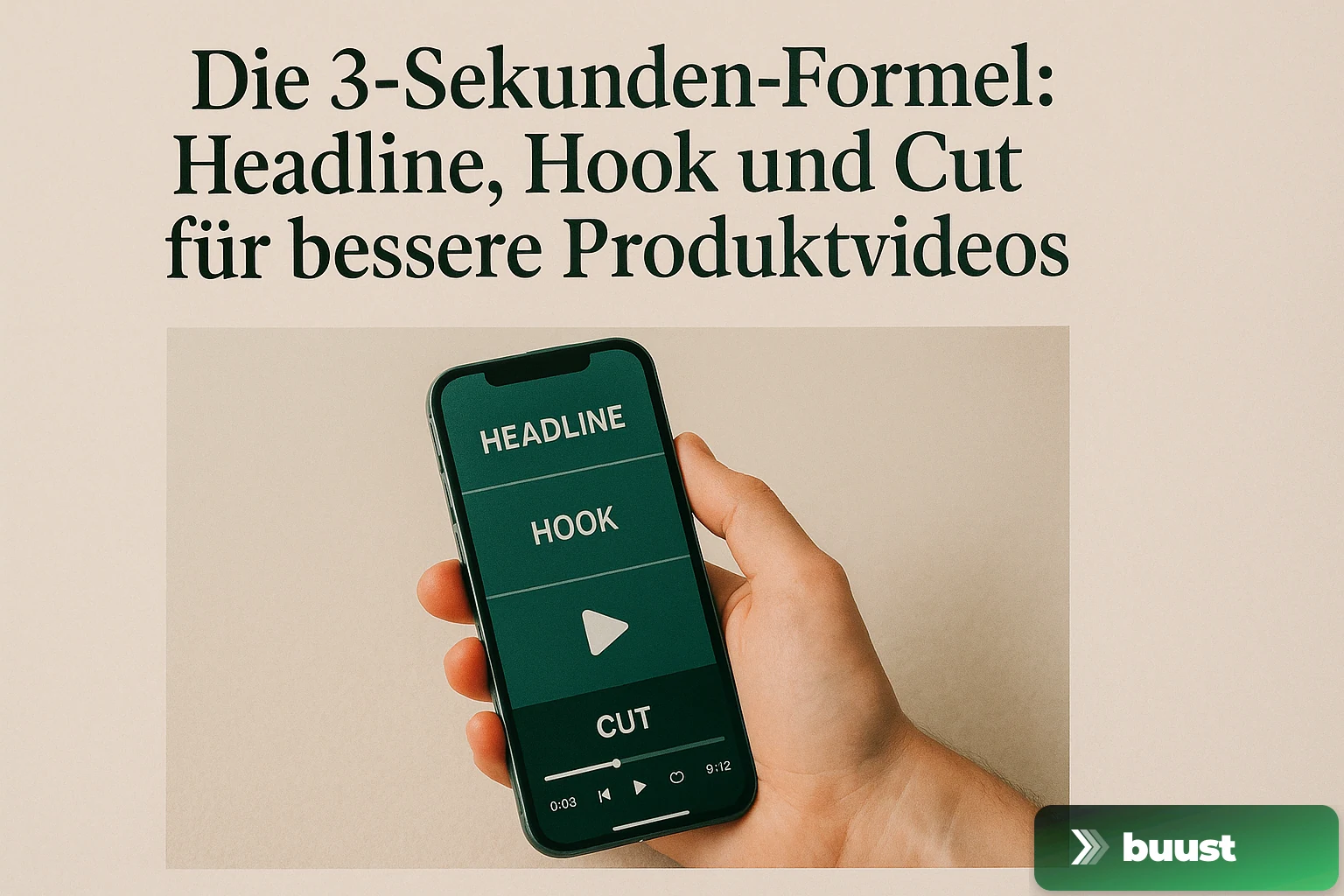
Anyone selling on TikTok, Reels or Shorts with product videos has exactly three seconds. Not five, not seven. Three. After that the user has either swiped on, or their brain has arrived in the video — and the second outcome is what you're working for.
Most product videos lose right in those three seconds. Not because the product isn't good. Because the opening gets wasted.
Why the first three seconds are so brutal
Every vertical feed algorithm runs the same mechanic: watch time determines reach. Anyone who swipes in the first seconds sends the algorithm a "not relevant" signal — and next time your video is served to someone, it starts with a handicap.
Concretely: if 60 percent of your viewers are gone after three seconds, your video barely gets served. If only 30 percent are gone, it runs to the 10-second mark. If 15 percent are gone, you go viral.
The first three seconds are the most important lever you have as a seller. Not the edit at the end. Not the music. Not the call to action. The opening.
The formula: second zero, one, two, three
Here's the breakdown that works most reliably in practice.
Second 0 to 1: strongest image without context
The first frame has to be visually so strong that the thumb pauses before the brain understands what it's seeing. That can be an extreme close-up, an unusual angle, a surprising color combination, a "what is that?" moment.
What does not work here: logos, brand names, classic product shots on white background, talking heads. The user sees all of that a hundred times a day — their brain has learned to swipe past in second zero.
Good example: a close-up on the texture of a wool sweater being pulled out of a wardrobe. Bad example: a model shot with the sweater, preceded by a logo intro.
Second 1 to 2: product in context
Now the brain is allowed to understand what it's seeing. The product appears in use, in a real setting, with a human reference. A hand, a motion, a shift from a detail to the whole.
This is also where the first real cut happens. From the close-up in second 0-1 to the medium shot. The cut isn't stylistic — it's functional. It pulls the brain back in case it was just about to swipe.
Good example: cut from the wool texture to a person pulling the sweater over their head. Bad example: long take on a static model shot.
Second 2 to 3: benefit, reveal or clear movement
By second three it has to be clear why the viewer should stick around. That's the benefit, the visual promise, the result. Sometimes a short on-screen text ("Stays warm for 30 hours"), sometimes an obvious demo (the product works on camera), sometimes a reveal (the product gets unboxed, opened, transformed).
Here's also the second cut, ideally with a slight slowdown of the edit rhythm. From second three on the video can breathe — not before.
Good example: person puts the sweater on, smiles, cut to the label "Merino · Organic · knitted in Germany." Bad example: talking head explains why this sweater is special.
Why cut frequency matters so much
On YouTube long-form you can afford shots that run ten seconds without a cut. On TikTok, Reels and Shorts you can never do that in the first three seconds. Every second without a cut is a second in which the brain asks: "Am I in the right place?"
Eye-tracking studies on short-form content show pretty clearly: the average shot duration in viral territory sits at 0.8 to 1.2 seconds in the first three seconds, then it can grow to 2 to 3 seconds. Anyone who fills the first three seconds with a single shot loses. No matter how beautiful the shot.
What bad hooks have in common
Looking at product videos that flop in the first three seconds, a few patterns stand out.
- Brand name first. No one cares about your brand before they know what you sell.
- Music intro without an image. Three seconds of music intro are three seconds of thumb-swipe.
- Static photo with text on top. A moving photo isn't a video — the brain catches that in 0.3 seconds.
- Talking head without product. "Hi, I'm Anna from …" has no business in second zero. Anna comes in at second 8.
- Long text overlay. Anyone expected to read two sentences in second one swipes on.
And finally: no cut in the first three seconds. Even if everything else is right — without a cut you lose.
What strong hooks have in common
Looking at product videos that perform strongly on TikTok or Reels, the commonalities are surprisingly consistent.
- The product is visible in second zero — often in detail, in close-up, or in motion
- There are at least two cuts in the first three seconds
- There's a slowdown of the cut frequency from second three on
- There's tension — a "what happens next?" feeling
- There's no brand in second zero, only once the viewer is already inside the video
None of this is complicated. It just contradicts what most sellers have learned as a "professional product video" — and that's exactly why it works.
How to actually pull this off
The theory is simple. The practice is the problem. Anyone trying to hand-build a three-second hook for 50 or 200 products is busy for weeks. Templates that have a three-second hook built in solve that problem — they take the product image and aspects from your listing and automatically build an opening that follows the second-by-second pattern.
With Buust you get templates designed for exactly this three-second formula: strongest visual impression first, product context in second one to two, benefit reveal in second three, then breathe. You pick a template per product, and the hook is automatically there — across your entire catalog.
Start free and see the difference between a three-second hook and your current video opening. On your top sellers, that's the difference between a Reel with 200 views and one with 20,000.
Common questions on the topic
How many cuts should a product video have in the first three seconds?+
At least two, ideally three. Every cut is a visual reset that holds the thumb. Static seconds in the first three are dangerous — they give the brain permission to move on. From second four on you can calm down.
Should I overlay text in the first seconds?+
Yes, but short and large. Three to five words, readable in half a second. Long sentences that force the reader to stop work on an ad poster — not in a Reel. If your text is longer than one breath, it's too long.
What's the most common hook mistake in product videos?+
Opening with the logo or brand name. Nobody cares about your brand at second zero — they don't know you yet. Open with the product in action, a result, or a visual contrast. Branding comes at the end, once interest is hooked.
Does every hook need to contain motion?+
Ideally yes. Motion is the biologically strongest stimulus a video can offer. If your product doesn't move itself (e.g. a piece of furniture), move the camera — pan, push-in, parallax. Static almost always loses to moving on social.
Ready to switch your listings to video?
10 videos free. No credit card. Connected in under 5 minutes.
Keep reading
Try it on right in your shop: how virtual try-ons cut returns
The most expensive return is the one that should never have happened — ordered "in two sizes to try". A virtual try-on answers the "does this suit me?" question before the purchase. Here's how try-on works in your own shop.
The Buust Score: how well does your listing actually sell — and what to do next
Most listings aren't bad — they're just weak in one spot, and nobody tells you which one. The Buust Score turns "optimize it somehow" into a single number and exactly one next step. Here's how to read it.

Seven Out of Ten Add to Cart — and Never Buy: Where Your Ready-to-Buy Visitors Disappear
They searched for your product, found it, added it to the cart — and vanished. These are not random visitors, these are your most ready-to-buy customers. Why they bail at the last moment — and how to kill the doubt before it kills the sale.