9:16 or 1:1? Which Video Format Actually Sells Where
Landscape, portrait or square — the wrong aspect ratio costs you reach before anyone even sees your product. An honest matrix of which format actually performs on which platform, and when a universal format is enough.

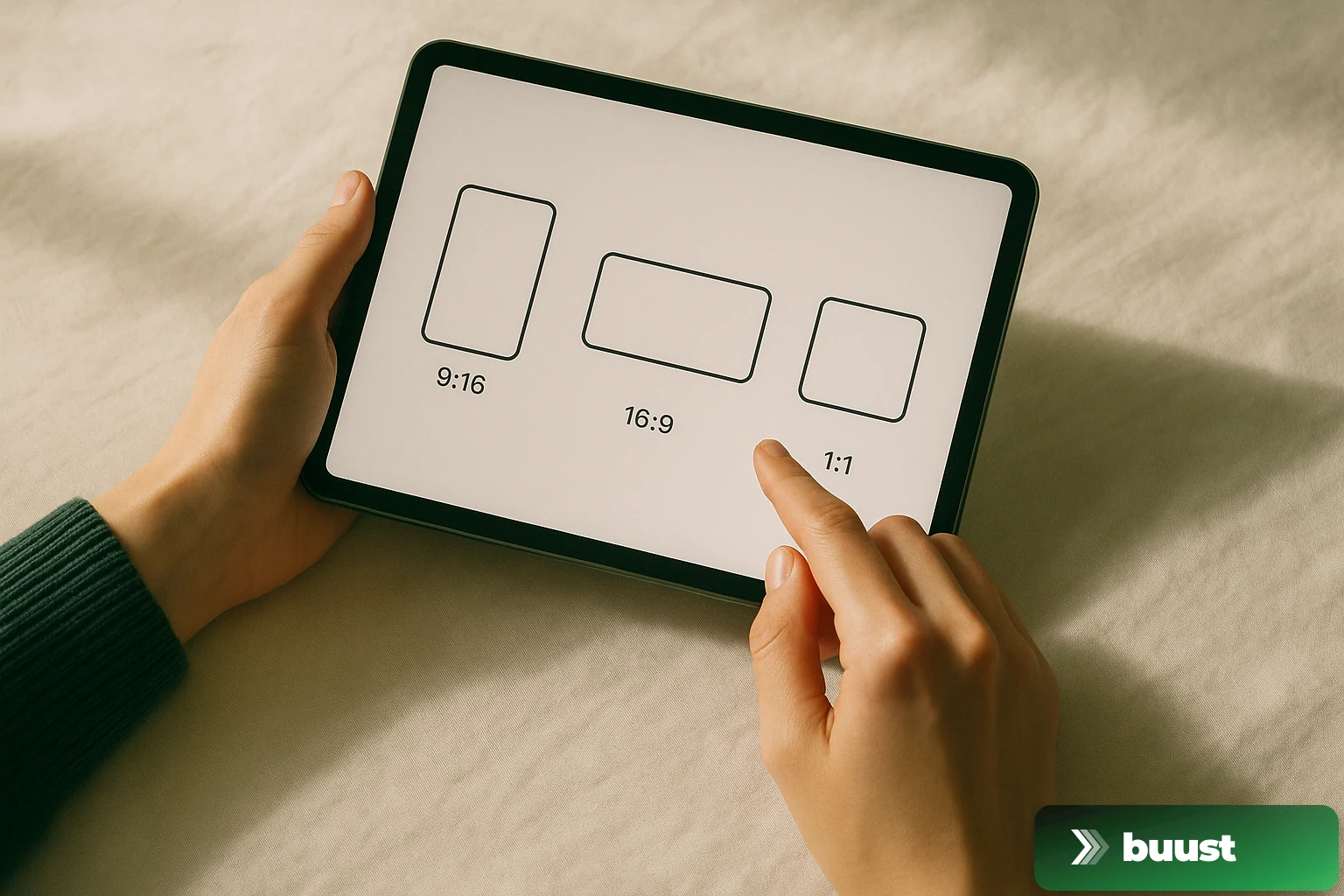
Format is the topic almost everyone underestimates. You think: "We have a product video, we'll just put it everywhere." Three weeks later you wonder why the Reel gets half the clicks of the competitor's, why LinkedIn embeds the video on a gray background, and why suddenly black bars show up on your own Shopify product page.
The problem is never the video itself. It's the aspect ratio.
Why format matters more than most think
Every platform has its own native algorithm, and every one of those algorithms prioritizes content that fully fills the available display. On TikTok that means 9:16. On a classic feed post on LinkedIn that means 1:1 or at most 4:5. A 16:9 video on TikTok is shown smaller, placed in the middle of the screen and is therefore less relevant — the algorithm recognizes: this is crosspost content, not native.
Platforms reward native because native keeps dwell time up. A Reel running with black bars on top and bottom demonstrably gets less watch time because users swipe sooner. Less watch time means less reach. Less reach means fewer sales.
So format isn't cosmetics. Format is distribution.
The honest matrix: which format goes where
Here's the breakdown that works best in practice:
| Platform | Recommended format | Backup format | Note | |---|---|---|---| | TikTok | 9:16 | — | 1:1 works technically, but reach measurably halves | | Instagram Reels | 9:16 | — | Same behavior as TikTok, no compromise | | Instagram feed post | 1:1 or 4:5 | 9:16 (double-post as Reel) | A square video wins in the classic feed; 4:5 takes more image space and is stronger in the feed | | Instagram Stories | 9:16 | — | Full-screen experience, anything else looks like a crosspost | | YouTube Shorts | 9:16 | — | Strictly vertical, no exceptions | | YouTube long-form | 16:9 | — | Classic video format, portrait loses here | | Facebook feed | 1:1 or 4:5 | 9:16 | Square works universally, 4:5 is feed-space winner | | Facebook Stories | 9:16 | — | Like Instagram Stories | | LinkedIn feed | 1:1 or 4:5 | 16:9 | Portrait performs strikingly badly on LinkedIn; square looks most professional | | Pinterest | 2:3 or 9:16 | 1:1 | Pinterest loves vertical, 2:3 is the native Pin format | | X (Twitter) | 16:9 or 1:1 | — | 16:9 is classic, 1:1 takes more feed space | | Threads | 1:1 or 9:16 | — | Loves square in the feed, portrait works too | | Shopify product page | 1:1 or 16:9 | — | Theme-dependent, but portrait almost always gets letterboxed | | eBay/Amazon gallery | 16:9 or 1:1 | — | Both render well, portrait often gets center-cropped |
The combinations that actually show up in practice
Most sellers don't need all twelve formats at once. They need the two or three that fit their channel mix. Here are the most common constellations.
Marketplace seller (eBay, Amazon) with some social: You primarily need 1:1 for listings and for Instagram/Facebook posts. If you also want to serve TikTok or Reels, 9:16 gets added. 16:9 is dispensable because your marketplace galleries also accept square.
Shopify brand with active social: You need 9:16 for Reels, Shorts, TikTok and Stories — and in parallel 1:1 for the product page and feed posts. Two renderings per product, no more.
B2B or premium brand with LinkedIn focus: 1:1 or 4:5 is mandatory, 16:9 for YouTube long-form as backup. 9:16 only when you explicitly want to serve younger audiences on Instagram or TikTok.
Multi-channel seller (everything at once): You need at least three variants per product — 9:16, 1:1, 16:9. Anyone doing that by hand spends half a day per product.
When you only get to pick one
Sometimes you don't have the time or the resources to render three variants. In that case the answer is clear: 1:1.
Square is the diplomatic compromise. It works on every platform, looks ideal nowhere but catastrophic nowhere. On a product page it fits. In the Instagram feed it fits. On Facebook and LinkedIn it fits. On TikTok it's shown smaller but at least not censored or invisible.
9:16 is stronger — but only when you put it where it belongs. In a marketplace listing a portrait video often looks amateurish because the gallery frames it with bars.
16:9 today is almost only a format for YouTube long-form and some shop themes. For everything else it's too wide.
The mistake that costs money
The most expensive mistake isn't the wrong format. It's the assumption that one format is enough for everything.
We see this constantly: a seller renders a 16:9 video, uploads it to Instagram, crops it into a square Reel, uploads it to TikTok with black bars — and wonders why no variant works. The truth is: none of these variants is the actual video. Each is a compromise, and each performs accordingly.
If you want to use social seriously as a sales channel, 9:16 isn't optional. It's native.
How to get the three formats without extra effort
Rendering, uploading and maintaining three variants per product manually is the reason most shops eventually land on "1:1 is enough." It's not a laziness problem, it's a time problem.
With Buust you connect your shop or marketplace account, pick a template per product, and automatically get all relevant formats generated — 9:16 for the vertical channels, 1:1 for feed posts and the product page, 16:9 where it makes sense. One click, and the right variant lands on the right channel.
Start free and try it with your three top sellers. If the portrait variant doesn't visibly boost your Reel views, you've lost nothing — if it does, you've gained an entire distribution layer from day one.
Common questions on the topic
If I'm only allowed to render one single format, which do I pick?+
Square (1:1). It works without cropping in feed posts on Instagram, Facebook and LinkedIn, holds up decently in marketplace galleries, and is rendered on TikTok in a not-ideal but visible way. 9:16 is stronger — but only where it belongs.
Is a 9:16 video a problem on a product page?+
Yes. Marketplace galleries and Shopify product galleries are designed for landscape or square formats. A portrait video gets embedded with black bars or center-cropped, which makes it look smaller and less professional. For the product page you need a dedicated variant.
Is 16:9 still worth it for YouTube Shorts?+
No, Shorts are strictly 9:16. You only need 16:9 for classic YouTube videos, longer tutorials and some shop embeds where a wide format shows more product detail.
Is it enough to render one video and crop it for every channel?+
Short-term yes, long-term you lose performance. A cropped portrait cut from a 16:9 master clips important image edges, the hook rarely sits in the right place, text drifts out of frame. Anyone serious about social renders per aspect ratio separately — ideally automated.
Ready to switch your listings to video?
10 videos free. No credit card. Connected in under 5 minutes.
Keep reading
Try it on right in your shop: how virtual try-ons cut returns
The most expensive return is the one that should never have happened — ordered "in two sizes to try". A virtual try-on answers the "does this suit me?" question before the purchase. Here's how try-on works in your own shop.
The Buust Score: how well does your listing actually sell — and what to do next
Most listings aren't bad — they're just weak in one spot, and nobody tells you which one. The Buust Score turns "optimize it somehow" into a single number and exactly one next step. Here's how to read it.

Seven Out of Ten Add to Cart — and Never Buy: Where Your Ready-to-Buy Visitors Disappear
They searched for your product, found it, added it to the cart — and vanished. These are not random visitors, these are your most ready-to-buy customers. Why they bail at the last moment — and how to kill the doubt before it kills the sale.