What happens when a jewelry seller suddenly has videos on eBay
Photos can never quite capture shine, material feel, and motion — video can. Why jewelry, watches, and cosmetics in particular benefit so heavily from moving content, and what lift ranges are realistic.

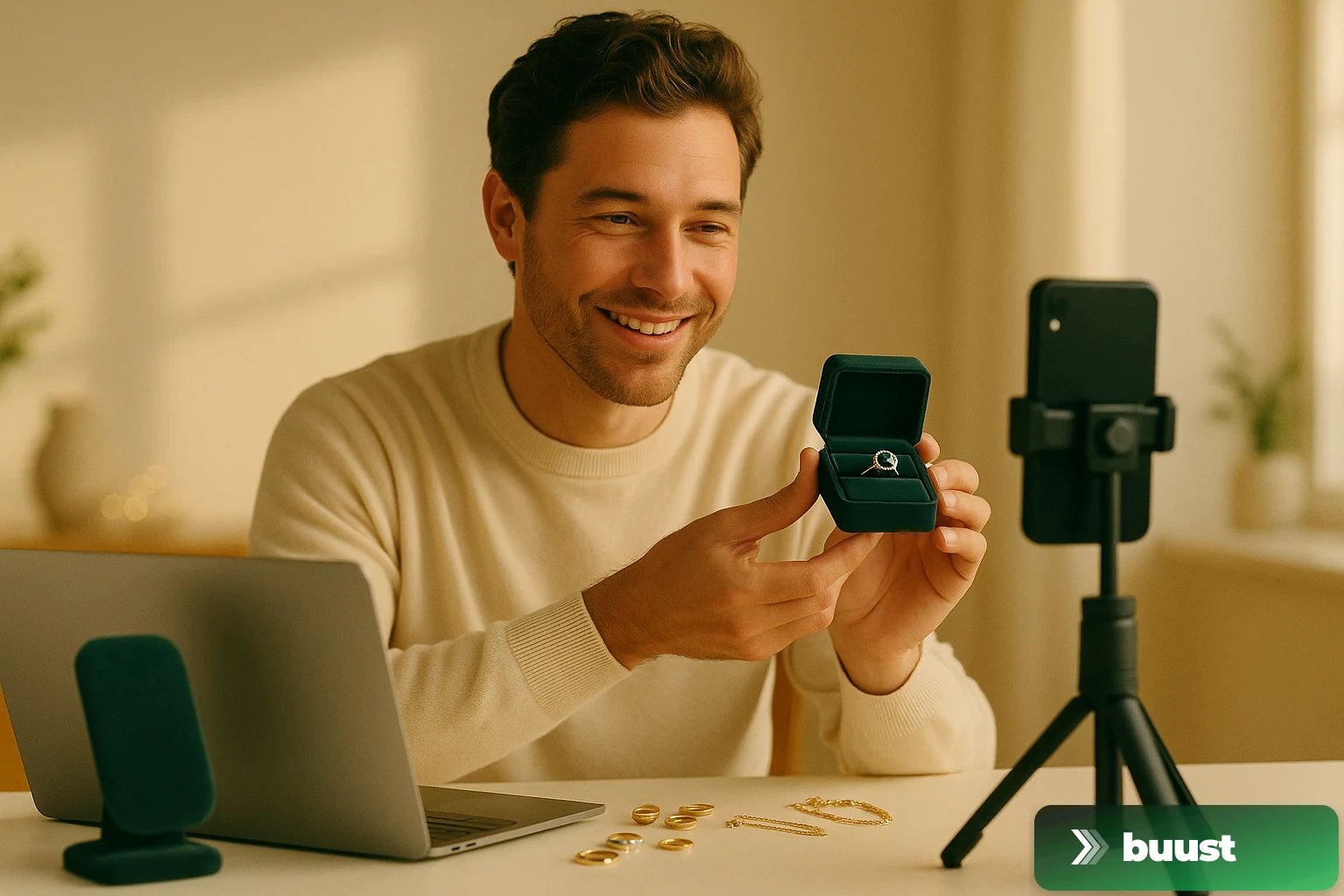
Imagine a jewelry seller with around 300 listings on eBay and a second sales channel via Etsy, who through early 2026 had only photos. Good photos, evenly lit, white background, classic product shot with a few detail captures.
Classic setup. Works. But nothing near as well as it could.
Why jewelry in particular has a video problem
Jewelry is one of the few categories where photo is structurally inferior. Three reasons:
- Reflection and shine: gold, silver, polished stones react to light movement. On a still image you see a static highlight — on video you see how the light travels across the surface. That's exactly the detail that makes buyers buy
- Workmanship in detail: a 3 mm wide ring has detailing that is barely visible in a photo at normal listing format. A video with zoom and a slow rotation shows the quality without the buyer having to tap each image individually
- Size perception: from a photo alone, it isn't immediately clear whether it's a delicate pendant or a 4 cm statement chain. Video with motion and possibly context (hand, neck, scale) solves that in two seconds
A static jewelry photo is like a trailer without sound. You understand what it is, but you don't feel anything.
What happens when video gets added
Take the jewelry seller in the scenario: 300 listings, no video in the mix. They start, generate bulk renders for all 300 listings, embed them on the eBay listings.
What realistically changes:
- Click rate from the search results list: industry-typical +15-30% on video thumbnails — buyers prefer the moving element to static preview images
- Time-on-page on the listing: often a doubling, because video holds the first 3-5 seconds and only then do buyers read the description
- Add-to-cart rate: realistically +10-20%, in shine-heavy sub-categories (stone-set rings, polished cufflinks) up to +30%
- Return rate: tends to drop, because buyers have a more realistic picture of the product
The +15-30% range on click rate isn't marketing speak — it's a magnitude that shows up in multiple industry-wide studies on the impact of video content on marketplaces. The exact number in any single case depends on competitive density — in densely populated categories the effect is bigger, because video continues to differentiate.
What buyers perceive in the background
There's a second, less visible effect that often only shows up after weeks: trust.
Buyers know in 2026 that many product images online are retouched, AI-generated, or staged by suppliers. With jewelry, that's especially critical — the question "does it really look like that in the picture?" sits in the back of every buyer's mind.
A video showing the piece in actual motion answers that question in 5 seconds. It signals: "The product physically exists, someone filmed it, you can see how the light reacts to it."
That isn't a nice detail. It's a trust anchor that shows up as higher conversion rates across the whole assortment — including listings you haven't added video to yet, because your shop overall feels more trustworthy.
Repeat purchases and brand recognition
A third effect that only shows up after 2-3 months: repeat buyers.
Anyone who has bought once from a shop where video is standard remembers the visual experience — not individual product photos. On the next jewelry search, the brand is back in mind, simply because it stood out from the photo-standard field.
In jewelry, where repeat purchases and gifts make up a big share of revenue, that's an underrated lever. An increased repeat rate of 5-15% over a year adds up substantially at this assortment size.
Which templates actually work
From the patterns we see across jewelry verticals, three template types stand out:
- 360-spin with light variation — rotation shows form, the light variation shows material quality. A classic for rings, pendants, earrings
- Detail zoom with slow pan — captures workmanship, works particularly well on filigree pieces or stone settings
- Lifestyle snippet — short sequence with hand, neck, or mirror reflection. Works mostly for statement pieces and gift categories
Rendering all three variants per listing and picking the strongest in the approval grid covers listing variety and testing needs at the same time.
Why other shine-heavy verticals benefit just as much
Jewelry isn't the only space where this effect hits this hard:
- Watches — same logic. Case reflection, dial detail, strap material. Video wins
- Cosmetics with packaging — glass flacons, mirror effects, brush motion — anything that lets motion "breathe" benefits
- Glass and ceramic tableware — light refraction, surface texture
- Leather goods with hardware — buckles, zippers, stitching under light movement
Anything that looks "flat" in a photo because a dimension is missing wins disproportionately with video.
What changes for the seller day-to-day
The shift is less dramatic than it sounds. In our jewelry seller's scenario, the rhythm looked like this:
- Week 1: 50 top sellers get video, click data check after 5 days
- Weeks 2-3: another 100 listings, in parallel an A/B test of different templates
- Weeks 4-6: rest of the catalog plus running refresh for new listings
- From month 2: every new entry gets video by default, effort per listing < 1 minute of active time
What noticeably changes day-to-day: fewer buyer questions of the "can you show me this up close?" kind, because the video already contains the answer. The time saved on customer inquiries alone is, depending on assortment, half a working day per week.
Where the effect is weaker
Honestly, this too: there are categories where video brings less even in jewelry. Pure mass-market categories with hard price orientation (e.g. simple hoop chains under €10) often show weaker lift, because buyers buy on price there, not on impact. But even there the trust effect remains — the brand as a whole feels cleaner.
In the high premium range (investment jewelry, real gold > €1,000), the effect looks different: less click rate, but higher conversion among the already interested. Different lever mechanics, same direction.
The pragmatic entry
With Buust, you connect your Shopify, your eBay account, or both, pull your jewelry catalog, and automatically render video variants for every listing. The pipeline combines spin, detail zoom, and lifestyle options out of your existing product photos.
You don't need a pro camera, no new lighting. If your current listing photos are reasonably clean, they're enough as input.
Start for free and see what your ten top jewelry pieces look like with video. If motion and light play convince you in the preview, you'll have your entire catalog updated within a few hours. If not — no commitment, no credit card, no risk.
Common questions on the topic
How many more clicks does video actually bring on jewelry listings?+
Industry-wide studies and internal platform data show a realistic range of +15% to +30% click rate. In individual tests with particularly shine-heavy jewelry, +40% to +50% have been reported. The exact number depends heavily on category, price level, and competitive density.
What makes jewelry so special compared to other verticals?+
Three factors: material reflection (gold, silver, stones play with light), small-detail effect (workmanship is hard to spot on photos), and emotional trigger (jewelry is often bought as a gift — motion creates the "wow" feeling a static photo can't).
Does this work for cheap fashion jewelry too, or only for high-ticket pieces?+
Both. For high-ticket jewelry, video justifies the price premium ("looks like what it costs"). For cheap fashion jewelry, it convinces buyers the quality is better than the price suggests. Same logic, different lever.
Is a normal product photo plus a spin animation enough, or does it have to be real motion?+
Both work, but differently. A 360-spin shows form, a real motion video shows behavior under light — which is the decisive selling moment for jewelry. Templates combining both (spin + detail close-up with light variation) usually deliver the best conversion numbers.
Ready to switch your listings to video?
10 videos free. No credit card. Connected in under 5 minutes.
Keep reading

Seasonality Without Stress: How a Garden Shop Re-Renders 60 Videos in 2 Hours Per Season Switch
Garden, outdoor, Halloween, Christmas — seasonal shops swap their entire assortment 3-4 times a year. Classically that's 2-3 weeks of photo block each time. With a template pipeline that becomes 2 hours. What that means for cash flow and stress levels.

From Solo Founder to Multi-Marketplace Brand: 90 Days with a Bulk Video Pipeline
What happens when a typical solo founder structures the first 90 days with a bulk pipeline? A realistic day-by-day plan — including the pitfalls nobody else talks about.
Pilot complete: LinkedIn is live — the professional channel we underestimated
Ten pilot sellers published their listing videos to LinkedIn automatically. Few views, but the most qualified conversations of the entire pilot run. As of today, LinkedIn profile posting is out of the pilot — the Company Page stays in for now.