From 8-Hour Photo Shoot to 100 Videos a Day: How a Typical Sneaker Reseller Rebuilds the Content Machine
Picture a typical sneaker reseller with 200 pairs: every model photographed individually, listings hand-written, video not happening at all. Here is what the rebuild to a bulk content machine actually looks like — realistic, not magical.

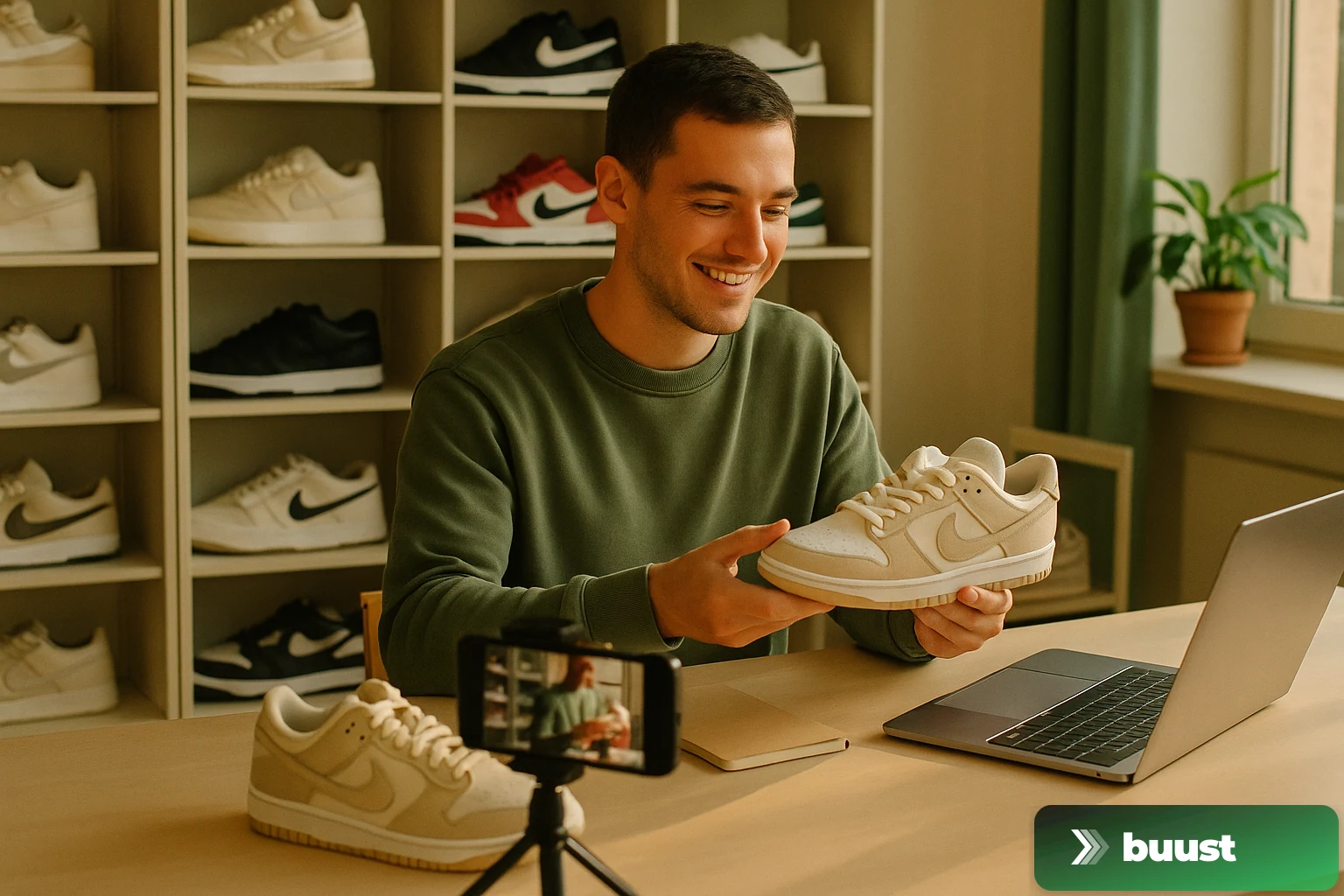
Picture a typical sneaker reseller. 200 pairs in stock, eBay as the main channel, Instagram half-maintained, a few photos per listing, copy-paste description with size variations. Solo, maybe with a student helper on weekends.
This isn't made up. This is the standard workflow of 90% of German sneaker resellers. And that exact workflow is why most get stuck between 50 and 200 listings.
The honest inventory
What does this typical reseller spend per sneaker in time?
- Photo shoot (3-5 images per pair, same setup): about 4 minutes per pair, with routine
- Listing creation (title, description, item specifics): 3-6 minutes
- Upload to eBay: 1-2 minutes
- Video: not included — postponed "for later"
For 200 listings that's 30 to 40 hours of pure listing work. Plus shipping, sourcing, buying, bookkeeping. No wonder video sits at number 14 on the to-do list and has been there for two years.
An 8-hour photo shoot every few weeks is the maximum the workflow allows. And after that shoot the images sit in a folder — videos don't get made because there's no time left.
What the market has changed
Two or three years ago, this was okay. Images were enough because every other reseller also had only images. eBay search was a flat feed sorted by title and price.
In 2026 it's different:
- eBay shows video thumbnails directly in search results in many categories
- Buyers from Reels and TikTok expect motion
- Mobile buyers scroll faster — anyone who isn't convincing in 2 seconds is gone
- Competitors with video rank algorithmically better because dwell time is higher
Anyone still doing video "later" is losing market share — even without doing anything wrong. The market moves on without them.
The rebuild in a typical setup
What does the switch look like when a reseller takes it seriously? Take a seller with 200 pairs, solo setup, a small storage room:
Step 1: Setup standardization (Day 1, about 4 hours)
- Photo area rebuilt: turntable or fixed floor marking, same lighting, same background
- 3 templates picked that fit the style (e.g., a spin-360 loop, a lifestyle cut, a detail close-up)
- Shop connection set up so listings flow automatically into the pipeline
Step 2: Asset refresh (Days 2-4, about 8 hours total)
- Each pair spun in front of the setup for 30 seconds and photographed from 4 angles
- 200 pairs × 30 seconds = roughly 100 minutes of pure photo time; with setup changes, breaks, and box handling, realistically 6-8 hours
- Images load directly into the pipeline
Step 3: Bulk render (Day 5, about 1 hour active time)
- Template applied to all 200 listings
- Pipeline renders 200+ videos overnight (often more, when multiple variants are generated per pair)
- Next morning: approval grid, quick sort, a few reruns on outliers
Step 4: Upload + social cadence
- Videos embedded on the eBay listings
- In parallel: Reels versions prepared for Instagram and TikTok
- Daily plan: 5-10 Reels per day, the 200-pair pool feeds 4-6 weeks
The realistic number: 100+ videos per day
The 100-videos-per-day number isn't magic. It falls out of the setup:
- A spin-360 setup gets through 60 pairs photographically in 30 minutes — once the routine clicks
- A pipeline renders 2-3 video variants per pair
- 60 × 3 = 180 renders from a morning of photo work
The real trick isn't filming faster. It's producing assets once and using them multiple times.
What actually changes after the rebuild
A typical reseller who takes this step usually reports similar things:
- Listing output triples, because video is no longer the bottleneck
- Click-through rate on eBay visibly rises, because video thumbnails stand out in search
- Instagram reach grows in passing, because 30-50 Reels go out per week instead of one
- Mental load drops, because "make videos" is no longer an open item
Most describe the feeling afterwards like this: "I don't have less to do, but the right thing is now automatic."
Where the rebuild fails in practice
Three pitfalls show up over and over:
- Too many templates — anyone starting with 15 variants sorts more than they produce. Three to five is enough, more just confuses
- Perfectionism on top sellers blocks the rollout — spending 5 hours per sneaker means you have 7 listings after a week, not 200
- Photo setup isn't standardized — changing exposure produces inconsistent renders, which destroys the brand effect
Pareto, not perfection. 80% consistent quality across all listings beats 100% perfect quality on three top listings.
What the rebuild means — emotionally
Let's be blunt: the main reason this switch doesn't happen isn't money or time. It's the fear that "bulk" automatically means "cheap."
It doesn't. Brand consistency across 200 listings is exactly the opposite of cheap. It's what the biggest resellers in Germany do — they just do it with agencies or staff while you do it with a pipeline.
The only difference: your cost per video is a fraction.
The pragmatic start
With Buust you connect your shop or eBay account, pull your entire inventory, pick templates, and render videos for all listings in parallel. The pipeline runs in the background, you check via approval grid at the end, and publish with one click.
You don't have to change your photo setup as long as the images are decent. You don't have to learn new software that takes a month to onboard. You start with 10 pairs, see what comes out — and then decide whether to run the full catalog.
Start free and see what your ten best-selling sneakers look like as bulk renders. If the result doesn't move you forward, you've lost nothing. If it does, you know what your content machine looks like starting next week.
Common questions on the topic
How do I get to 100 videos a day with 200 sneakers in inventory?+
Not by filming 100 times. By shooting a spin-360 setup or a short photo series once per model, and then having a template pipeline render one video per SKU. The manual part is the assets, the rest runs automatically.
Are standard templates enough, or do I have to design every video individually?+
Pareto beats perfection. Three to five good templates cover 80-90% of your listings. For top sellers or limited drops you can rework individually — but not for every Air Force 1 in stock.
How long does the rebuild really take?+
The setup part — picking templates, connecting the shop, checking first test renders — realistically takes half a day to a full workday. After that, 100 videos a day is not the exception but the normal output speed, as long as the assets exist.
Doesn't this make listings uniform and boring?+
The opposite. A consistent visual style across all listings reads as a brand — not as 200 random entries. Buyers recognize what belongs to your shop. That's trust, not boredom.
Ready to switch your listings to video?
10 videos free. No credit card. Connected in under 5 minutes.
Keep reading

Seasonality Without Stress: How a Garden Shop Re-Renders 60 Videos in 2 Hours Per Season Switch
Garden, outdoor, Halloween, Christmas — seasonal shops swap their entire assortment 3-4 times a year. Classically that's 2-3 weeks of photo block each time. With a template pipeline that becomes 2 hours. What that means for cash flow and stress levels.

From Solo Founder to Multi-Marketplace Brand: 90 Days with a Bulk Video Pipeline
What happens when a typical solo founder structures the first 90 days with a bulk pipeline? A realistic day-by-day plan — including the pitfalls nobody else talks about.
Pilot complete: LinkedIn is live — the professional channel we underestimated
Ten pilot sellers published their listing videos to LinkedIn automatically. Few views, but the most qualified conversations of the entire pilot run. As of today, LinkedIn profile posting is out of the pilot — the Company Page stays in for now.