Spin-360 vs. Lifestyle Reel: Which Video Style Fits Which Product
Not every product sells with the same video style. A spin-360 is brilliant for sneakers — and flops for cosmetics. A lifestyle Reel saves home decor — and hides the detail on jewelry. Which style fits which product.

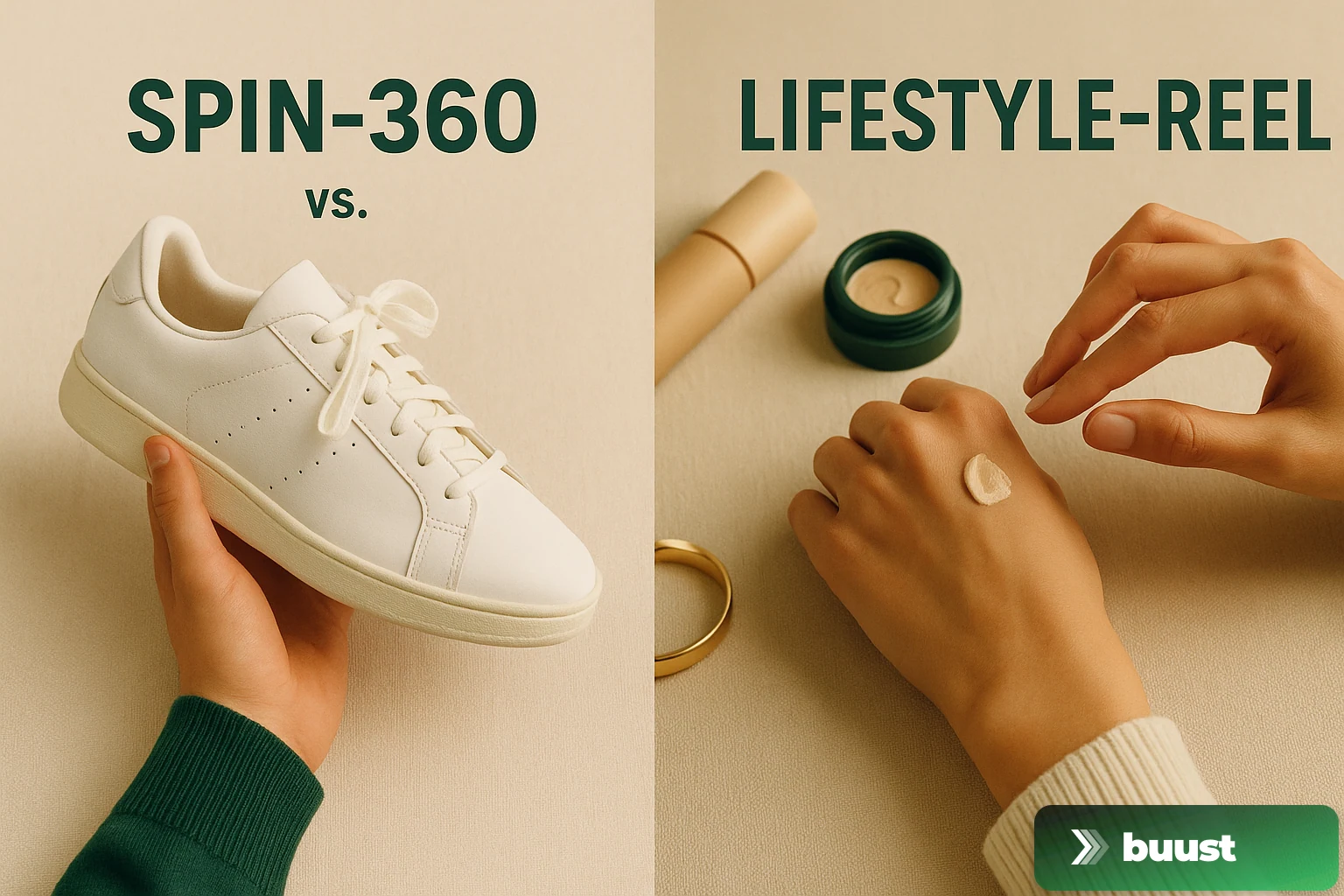
If you're deciding right now whether to do a spinning 360-degree shot or a scenic lifestyle video for your products, the honest answer is: it depends. But not in the way most people think.
It doesn't depend on the seller's taste. It depends on the one question the buyer has in their head in the first few seconds. And that question is radically different depending on the product category.
The one question behind every click
When someone looks at a sneaker, their brain asks: "What does it look like from behind? What's the sole like? How is the logo placed?" Detail decides.
When someone looks at a scented candle, their brain asks nothing detail-oriented. It asks: "What's the feeling when it's in my living room? What mood does it create?" Emotion decides.
That's the fault line. Spin-360 answers detail questions. Lifestyle Reels answer feeling questions. And most sellers get it exactly backwards.
When a spin-360 wins
A spin-360 is the right answer when the product itself is the main attraction and the buying decision hinges on a detail you have to rotate, tilt, or see from behind.
Three categories where spin-360 is almost always the better style:
- Tech gadgets — ports, buttons, material quality, weight distribution. Anyone buying headphones wants to see the cushions. Anyone buying a power bank wants to count the ports.
- Jewelry and watches — sparkle lives off motion. A static photo of a diamond ring looks like glass. A rotated shot captures the glint at every angle. With watches, the profile also matters — height, lugs, strap connection.
- Sneakers and shoes — buyers want the silhouette from the side, the sole from below, the heel tab from behind. Sneaker communities have specific detail expectations that a single front shot never fulfills.
What else spin-360 does: it signals "the product really exists." When counterfeits are a worry, a 360 spin can't be faked, a stock photo can.
When a lifestyle Reel wins
A lifestyle Reel is the right answer when the product lives in a context and the buying decision hinges on a feeling. Here it's not the material that sells, but the imagination.
Three categories where lifestyle Reels beat the spin:
- Cosmetics and care — nobody buys a foundation to rotate the packaging. Buyers want to see how the texture looks on skin, how the color reads, how the brush draws. Lifestyle with hand, model, mirror scene.
- Home decor and furniture — a chair on white is information, not a sale. The same chair in a living room with daylight and a throw — that's "I want it." Decor lives off the room.
- Fashion and apparel — fabric falls differently when someone moves. How long are the pants really? How wide the cut? How heavy the fabric? Lifestyle with movement answers all three in five seconds.
What else lifestyle Reels do: they perform drastically better on social platforms. Pure studio spins barely work on Reels and TikTok — the algorithm recognizes them as ads and throttles reach. Lifestyle reads as organic.
When you need to go hybrid
Some products aren't solved by pure spin or pure lifestyle. That's when you need the hybrid cut — 3 to 4 seconds of detail, 5 to 8 seconds of usage, a closing frame with logo or price.
Classic hybrid candidates:
- Kitchen appliances — material and function both have to be shown. The beautiful stainless steel mixer is worthless if you can't see how the attachment clicks on.
- Outdoor equipment — a tent in a studio says nothing. A tent by the lake says everything. But anyone not showing seam and zipper detail isn't selling either.
- Tools and DIY — buyers want to see the build quality (spin) and that it actually works (lifestyle). No drill sells without a quick drilling shot.
- Pet supplies — the dog bed on white is furniture. The dog bed with a dog in it is conversion.
Pros and cons in direct comparison
| Aspect | Spin-360 | Lifestyle Reel | |---|---|---| | Strength | Detail fidelity, trust signal | Emotion, use case | | Weakness | Cold, hard on social | Hides product details | | Production effort | Low (no model needed) | Higher (set, model, lighting) | | Best placement | Product page position 1 | Social Reels, product page position 2 | | Conversion effect | Strong with detail buyers | Strong with impulse buyers | | Algorithm performance on social | Weak | Strong |
Where sellers stumble in practice
The most common mistake isn't choosing the wrong style, it's choosing one style for all products.
Anyone with 200 listings rolling out a 360 spin on each has a consistent collection — and underperforms on half the products. Anyone doing all 200 as lifestyle has an emotional brand — and loses on every detail-driven purchase.
The solution isn't to think through every product individually. The solution is a category rule: jewelry always spin, cosmetics always lifestyle, tech always hybrid. Define once, then scale.
The pragmatic path to bulk execution
This is exactly where most shops fail. Not at the concept, but at execution across hundreds of products. Anyone who has to switch styles per listing, shoot individually, edit, upload, gives up after the first twenty products.
With Buust you connect your shop or marketplace account, assign a template to each category — spin for jewelry, lifestyle for decor, hybrid for tools — and the whole catalog renders according to your rule. You decide the strategy, the execution runs in the background.
Start free and render your three top products in two different styles. You'll see directly which style pulls per product — before you commit to your catalog rule.
Common questions on the topic
What's the difference between spin-360 and lifestyle Reel?+
A spin-360 shows the product from every angle against a neutral background — focus on the object itself. A lifestyle Reel shows the product in use, with a person, room, or scene — focus on emotion or benefit.
Can I just do both for a product?+
Yes, and for mid-priced products from €50 up it's often worth it. Spin-360 as the first video on the product page, lifestyle Reel as the second — or the other way around, depending on the buyer journey. On social, the lifestyle Reel usually performs better; on the product page, the spin-360.
How long should a product video ideally be?+
On product pages, 6 to 12 seconds, muted and looping. On social Reels and Shorts, between 8 and 25 seconds. Longer videos are never watched to the end on listings, and on social only if the hook pulls in the first 1.5 seconds.
Which style fits products that need explaining?+
Hybrid cuts with a spin element for the material and a short usage sequence for the function. Pure lifestyle Reels often leave buyers of technical products asking "how does this actually work?" Pure spins don't answer the use case.
Ready to switch your listings to video?
10 videos free. No credit card. Connected in under 5 minutes.
Keep reading
Try it on right in your shop: how virtual try-ons cut returns
The most expensive return is the one that should never have happened — ordered "in two sizes to try". A virtual try-on answers the "does this suit me?" question before the purchase. Here's how try-on works in your own shop.
The Buust Score: how well does your listing actually sell — and what to do next
Most listings aren't bad — they're just weak in one spot, and nobody tells you which one. The Buust Score turns "optimize it somehow" into a single number and exactly one next step. Here's how to read it.
Seven Out of Ten Add to Cart — and Never Buy: Where Your Ready-to-Buy Visitors Disappear
They searched for your product, found it, added it to the cart — and vanished. These are not random visitors, these are your most ready-to-buy customers. Why they bail at the last moment — and how to kill the doubt before it kills the sale.