Cross-Border Selling: Why Your Video Needs Three Different Cuts for DE, FR and PL
A product video that sells in Germany often flops in France — and vice versa. Localization is more than language: pacing, hooks, color grade and CTA follow cultural patterns. How to maintain three versions pragmatically, without shooting three times.

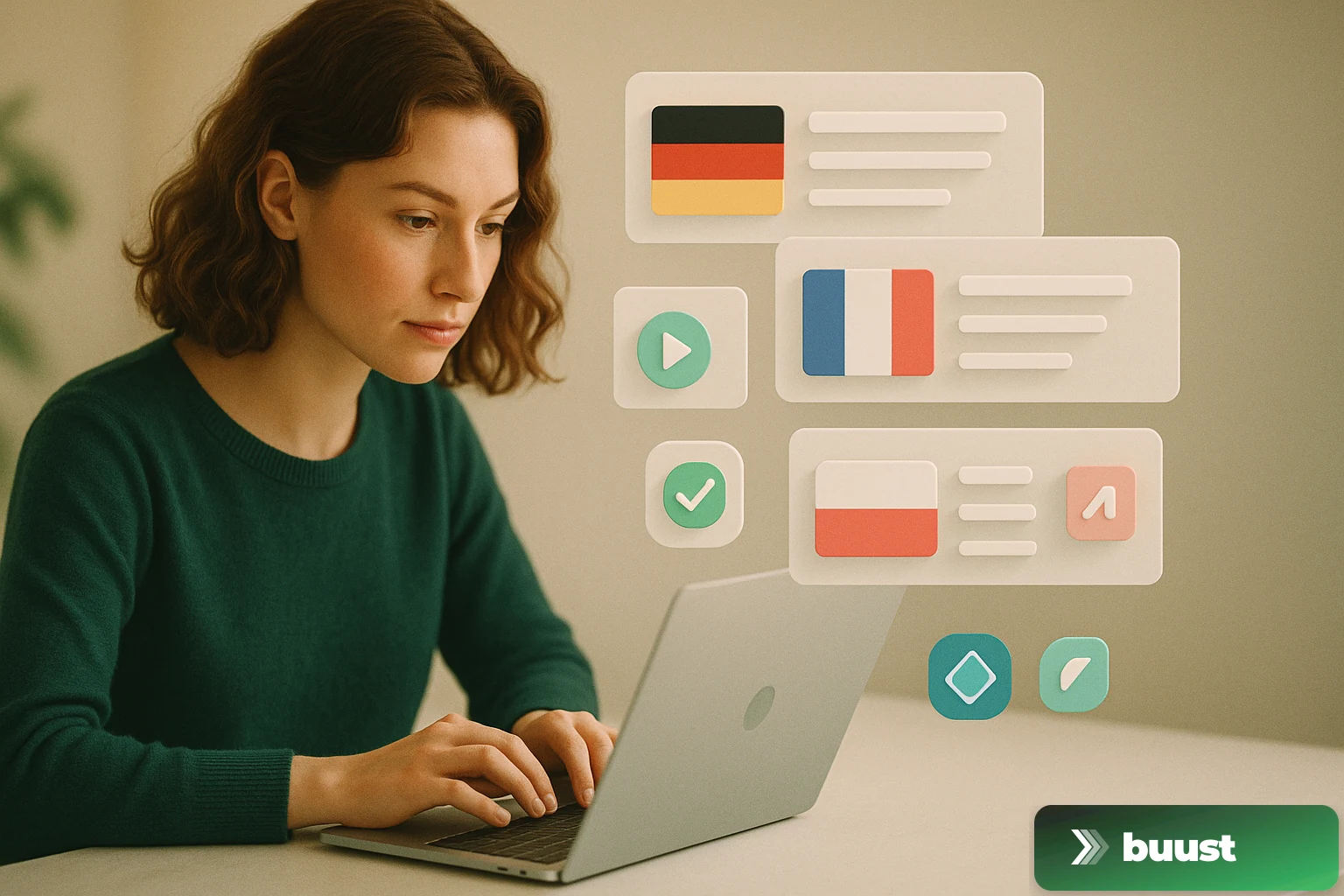
If you sell in more than one European country, you probably have the same reflex as 95 percent of all cross-border merchants: you produce one product video, export it in different language versions, upload it everywhere, and think you are localized.
That is not localized. That is translated. The difference is substantial — and it decides whether your video does its job in Lyon, Krakow or Cologne.
What localization really means
A buyer in Hamburg, a buyer in Marseille and a buyer in Warsaw have three very different visual expectations. That has nothing to do with taste, it is decades of conditioning through local marketing, local TV spots, local social content culture.
- The German buyer looks for clarity first in a product video: what is it, what is it for, what can it do. Function before form.
- The French buyer looks for aesthetics first: does it look beautiful, does it feel premium, does it fit my way of life. Form as filter, function after.
- The Polish buyer looks for value for money first: what do I get for my money, does it look well made, is the seller serious. Pragmatism before emotion.
These differences are not stereotypes. They are measurable in conversion data — and anyone running a single video for all three markets is, at best, serving one, and usually none, of them optimally.
Pacing: how fast can your cut be
Cut frequency in a product video is one of the most underestimated localization topics.
- German: average cut length 1.5 to 2.5 seconds, clear transitions, one detail per cut. One main point per sequence, then seamlessly on.
- French: longer cuts (2.5 to 4 seconds), more establishing shots, more space for atmosphere. Soft transitions, often with fade.
- Polish: faster (1 to 2 seconds), more information per second, prominent text overlays, clear price or benefit communication.
Throw a fast Polish cut at the French market and it feels aggressive. Export a slow French cut to Germany and it feels indecisive. Send a mid-pace German cut to Poland and it feels boring.
Hooks: what goes into the first second
The first second decides everything. What sits there has to fit culturally — otherwise the buyer scrolls.
- DE hook: function or problem solution. "X reduces Y by Z." Plain text, often a text overlay on the first frame.
- FR hook: mood or symbol. A hand, a light fall, an elegant context — with the brand name later, not first.
- PL hook: price or benefit signal. Percent number, comparison value, clear value statement in the first frames.
These hooks are not made up, they mirror local advertising conventions. Buyers are trained to expect a certain signal in the first seconds. If the signal is off, interest falls off — before the buyer has even decided whether the product is relevant to them.
CTAs: what has to be at the end
The call-to-action at the end is also not universal.
- DE: "Discover now", "Learn more", "View in shop" — factual, no pressure. Aggressive CTAs ("buy now", "grab yours") often feel sketchy in DE.
- FR: "Découvrir", "Voir la collection" — invitation, not command. French buyers react badly to direct purchase prompts, well to promises of style.
- PL: "Sprawdź teraz", "Zobacz cenę" — more direct, often with concrete price reference. Polish buyers want to know what awaits them before the click.
Anyone simply translating an aggressive English CTA like "Shop Now" lands at "Achetez maintenant" in France — which culturally feels roughly like "buy it already" would in Germany. The tone is off.
Color grade: the invisible localization
The final point is the most subtle — and the one most brands completely miss. Color grade, the tonal balance of the video, has regional conventions.
- DE: rather cool-neutral tones, slightly desaturated, high contrast. Feels clean, technical, trustworthy.
- FR: warmer tones, slight sepia tilt, softer midtones. Feels refined, atmospheric, premium.
- PL: brighter, more clearly saturated colors, deeper blacks. Feels friendly, inviting, energetic.
This is not subjective — streaming platforms, local ad agencies and market research have confirmed these patterns for years. A video that is wrongly graded for its market feels hard-to-place "off" — the buyer cannot name why, but trust drops.
How to do this in practice without shooting three times
The good news: you do not need to produce a new video for every country. The pragmatic workflow looks like this:
- One master render with modular sequences. Detail shot, application scene, hook frame, closing frame — all available separately.
- Per country, four axes are adjusted: sequence order, pacing (cut length), text overlay (language and style), color grade.
- Music often stays the same, as long as it is instrumental and culturally neutral. Voice-over is re-recorded per language, if used.
- Closing frame localized: CTA, price display, promise — different per market.
With this approach, in 15 to 30 minutes per country you turn a master cut into a localized version that fits culturally — without having to finance a new production.
What you gain when you do it right
- Higher conversion rate per local market, because the video "feels right"
- Better social performance, because algorithms prefer local content over imported
- Lower ad costs, because your creative feels more relevant per country
- Stronger brand trust, because your presence does not feel like a US import brand, but like a local provider
Where sellers trip up in practice
We see three mistakes again and again across cross-border brands:
- English as a convenience default: using one English video everywhere because "everyone understands it". Not true — conversion studies show 20 to 40 percent conversion loss against native-language versions.
- One video for Romance languages: lumping FR, IT, ES together. Works on the surface but performs sub-optimally. Italian and Spanish buyers have different visual expectations than French ones.
- Treating localization as translation: subtitles and a new CTA are not enough. Pacing and color grade have to come along.
The pragmatic path to localized cuts
With Buust you pick your product, define your target markets — and the system generates the matching cut per country with the right pacing, localized text overlay, market-appropriate color grade and linguistically adapted CTA. You manage a product strategy, not thirty individual videos.
Start for free and have one of your top products rendered in three versions — DE, FR, PL. You see directly in comparison what localization beyond language really means.
Common questions on the topic
Is it not enough to just translate subtitles?+
No. Subtitles solve the language problem, not the expectation problem. A French buyer expects a different pace, different visual language, different visual codes than a German one. Subtitles on a German cut feel like an imported video in France — and that is exactly what lowers conversion rate.
How many localized cuts do I realistically need?+
For most European brands, three are enough: DACH, Romance (FR/IT/ES) and CEE (PL/CZ/RO). The UK is distinct enough that a fourth cut pays off once volume justifies it. Scandinavia and Benelux often work fine in practice with the DACH cut.
Is the effort worth it for smaller markets like Poland?+
If your PL revenue share is above 5 percent, yes. The Polish market is price-sensitive but high-growth — especially on marketplaces like Allegro and Amazon.pl. A localized cut with a price-focused hook often raises conversion there more than in any western European market.
Do I have to shoot a new master for every cut?+
No, that would be economically nonsense. The pragmatic path: one master render with modular sequences — detail shot, application, hook frame, closing frame. Per country, order, pacing, text overlay, music and color grade get adjusted, not the raw footage.
Ready to switch your listings to video?
10 videos free. No credit card. Connected in under 5 minutes.
Keep reading
Buust for your own shop: JTL, Shopware, Gambio, OXID, PrestaShop & more
Video tools almost always target Shopify. If you run a self-hosted shop, you watch from the sidelines. We're changing that: one plugin per system that writes the finished video straight into your product description — JTL, Shopware, Gambio, OXID, PrestaShop and more.
Does the video really work? How we measure revenue uplift honestly
Every vendor claims their tool lifts revenue. Almost none can prove it was the tool and not the season. We measure video uplift with difference-in-differences — and we'll also show you when nothing happened.

From Listing to Buyer: How Buust Brings One Product to 12 Channels
You connect your store, Buust pulls the products, generates videos, embeds them in your listings, and posts them to eight social channels. Here is the whole workflow at a glance — and why buyers decide differently with video.