Three Marketplaces, Three Different Stories — and Why That Costs You Buyers
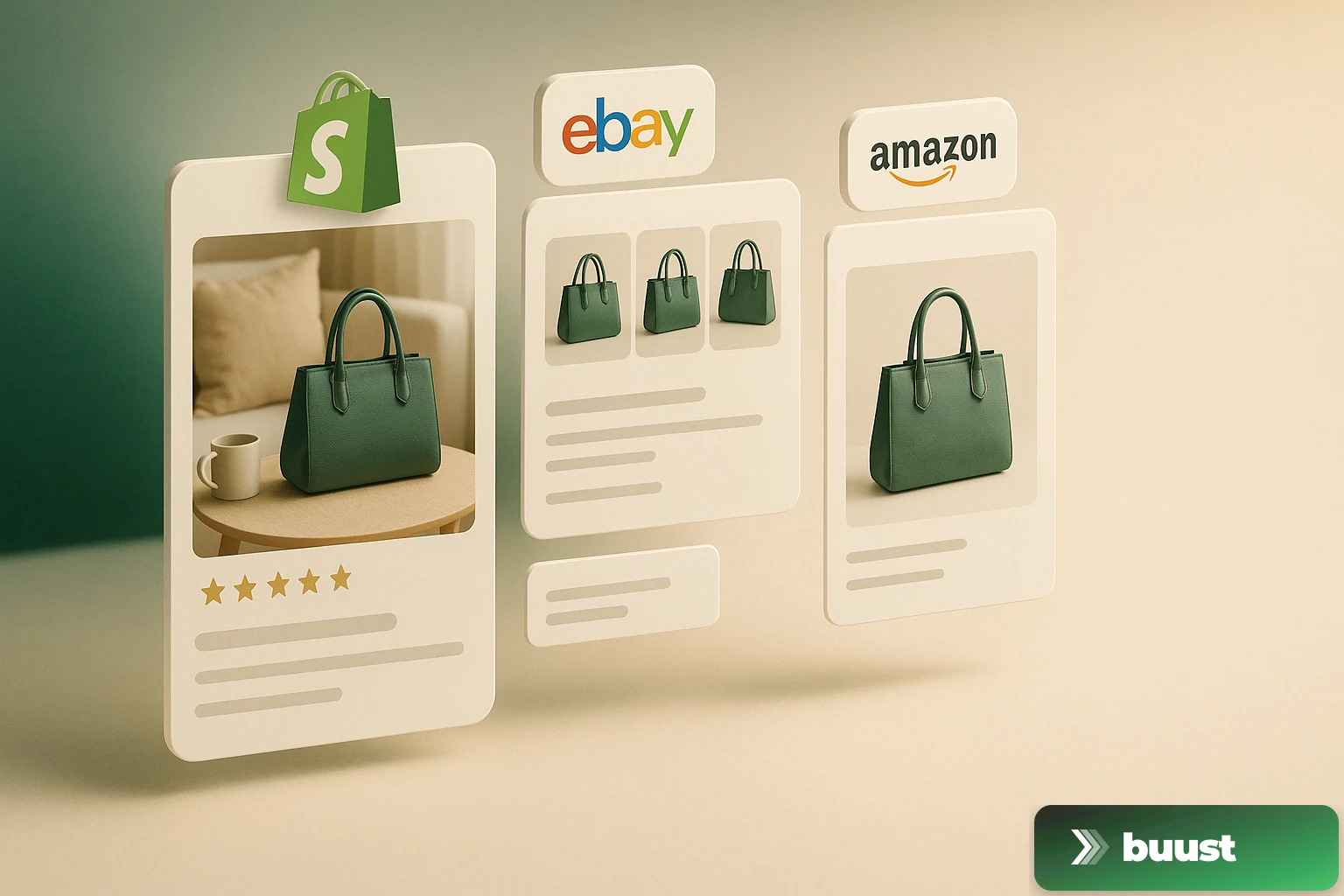
On Shopify you show lifestyle. On eBay three stock photos. On Amazon just the hero image. Buyers research across platforms today — and they notice when your brand looks different on every channel. What inconsistent listings actually cost you.

You sell on Shopify, eBay and Amazon. Maybe also on Kaufland, OTTO or Etsy. On paper you're a multi-channel seller. In practice you're probably three different brands — and your buyer notices.
The invisible break that costs you sales
Picture this: a prospective buyer sees your product first on Amazon. Hero image on white, three additional photos, no video. Solid impression, but generic.
He googles the product — lands on your Shopify shop. Lifestyle photos, a video, a beautifully designed product page. Suddenly it feels different. Premium, more personal.
Then he sees it on eBay. Three stock photos from the wholesaler, no video, a description with bullet points from 2018. The same product looks like a different offer, maybe even like a fake listing.
In that moment, nothing conscious happens in his head. But the trust your Shopify page built is gone. He isn't sure anymore which seller you actually are.
Why this hurts so much
Multi-channel only works if the buyer recognizes you as the same brand on every channel. As soon as one channel breaks ranks, one of three things happens:
- He buys from the competitor who looks solid everywhere
- He buys from you, but on your weakest channel — where your margin is thinnest
- He keeps searching and forgets about you along the way
All three outcomes cost you money. The third one especially, because you don't even know it's happening.
Why staying consistent is so hard
Every platform has its own rules. Own image formats, own video specs, own title lengths, own description fields. What's allowed on Amazon is forbidden on eBay. What Shopify shows doesn't fit OTTO's layout.
If you maintain every listing per platform manually, every new product needs:
- 5 different image crops
- 3 different title variants
- 2 adapted descriptions
- 1 video, plus its reformats
- Hours of clicking through 5 different backends
Manageable at ten products. A nightmare at a hundred. At a thousand, a reason to simply give up — which most people then do. They publish the minimum on every channel and hope the buyer doesn't notice.
He notices.
What works: one source, many outputs
Successful multi-channel sellers have a different workflow. They maintain their content truth in a single place — and let the platform-specific variants be generated from it.
Concretely:
- One central library of product images, cleanly cataloged
- One video per product that gets auto-converted into all needed formats (portrait, landscape, square)
- One master description from which platform-specific variants are generated
- One click that updates everything when price, availability or photo changes
This isn't "nice to have." This is the difference between a shop that grows across three channels and one that sabotages itself across three channels.
The video angle specifically
Video is now not only allowed but preferred on most marketplaces:
- eBay shows video in the main gallery from listing start, Best Match rewards engagement
- Amazon allows Brand Story and hero video, with measurable conversion lift
- Shopify supports video natively in Online Store 2.0 themes
- OTTO, Kaufland are gradually following
Still, most sellers have video on at most one of these channels. Why? Because shooting, editing and uploading a video per platform manually blows past the scaling limit.
This is exactly where the biggest lever of the next 18 months sits: anyone who can produce a video once and deploy it everywhere in platform-appropriate format gets a visible edge — precisely because so few do it.
What changes specifically
- Brand recognition across every channel, with the effect that the buyer trusts you on second contact
- Higher conversion on the weaker channels because they finally show the same level as your strong channel
- Lower maintenance per product — one change at the source is enough
- More leverage with every individual platform because you're no longer dependent on one channel
The pragmatic start
You don't have to sync every channel at once. Start with the two most important — usually Shopify plus one marketplace.
With Buust you connect both accounts in under five minutes. Buust pulls all products together, generates a video per product, formats it for each platform, and publishes it back to the respective listing. Descriptions, images and status stay synced.
You keep working the way you did — only now your buyer sees you as the same brand on every channel.
Start free and connect your first two channels. Three free videos per platform, no risk, a visible difference in thirty minutes.
Common questions on the topic
Do buyers really research across multiple marketplaces before buying?+
Yes. Studies show more than half of buyers look up a product on at least two platforms before ordering — typically Amazon plus Google plus your shop. Anyone who sees the same product presented differently everywhere gets suspicious.
Do listings have to be exactly identical on every platform?+
No, they have to be platform-appropriate. Amazon titles follow different rules than Shopify titles. But the visual experience — imagery, video style, color world, tone — should be recognizable across every channel.
What matters more: many platforms or consistent platforms?+
Consistent beats many. Two marketplaces with professional, unified listings convert better than five half-finished ones. Depth first, then breadth.
How do you keep listings up to date across all channels?+
Manually it's a full-time job. A central content source (images, videos, descriptions) and a tool that derives the right formats per platform is the only approach that scales.
Is multi-channel worth it at all if you're strong on one channel?+
Almost always. Buyers who discover you on Amazon and find you again on your Shopify shop are more likely to buy direct — which raises your margin. Platform independence is also a risk buffer when one platform changes the rules.
Ready to switch your listings to video?
10 videos free. No credit card. Connected in under 5 minutes.
Keep reading
Buust for your own shop: JTL, Shopware, Gambio, OXID, PrestaShop & more
Video tools almost always target Shopify. If you run a self-hosted shop, you watch from the sidelines. We're changing that: one plugin per system that writes the finished video straight into your product description — JTL, Shopware, Gambio, OXID, PrestaShop and more.
Does the video really work? How we measure revenue uplift honestly
Every vendor claims their tool lifts revenue. Almost none can prove it was the tool and not the season. We measure video uplift with difference-in-differences — and we'll also show you when nothing happened.
From Listing to Buyer: How Buust Brings One Product to 12 Channels
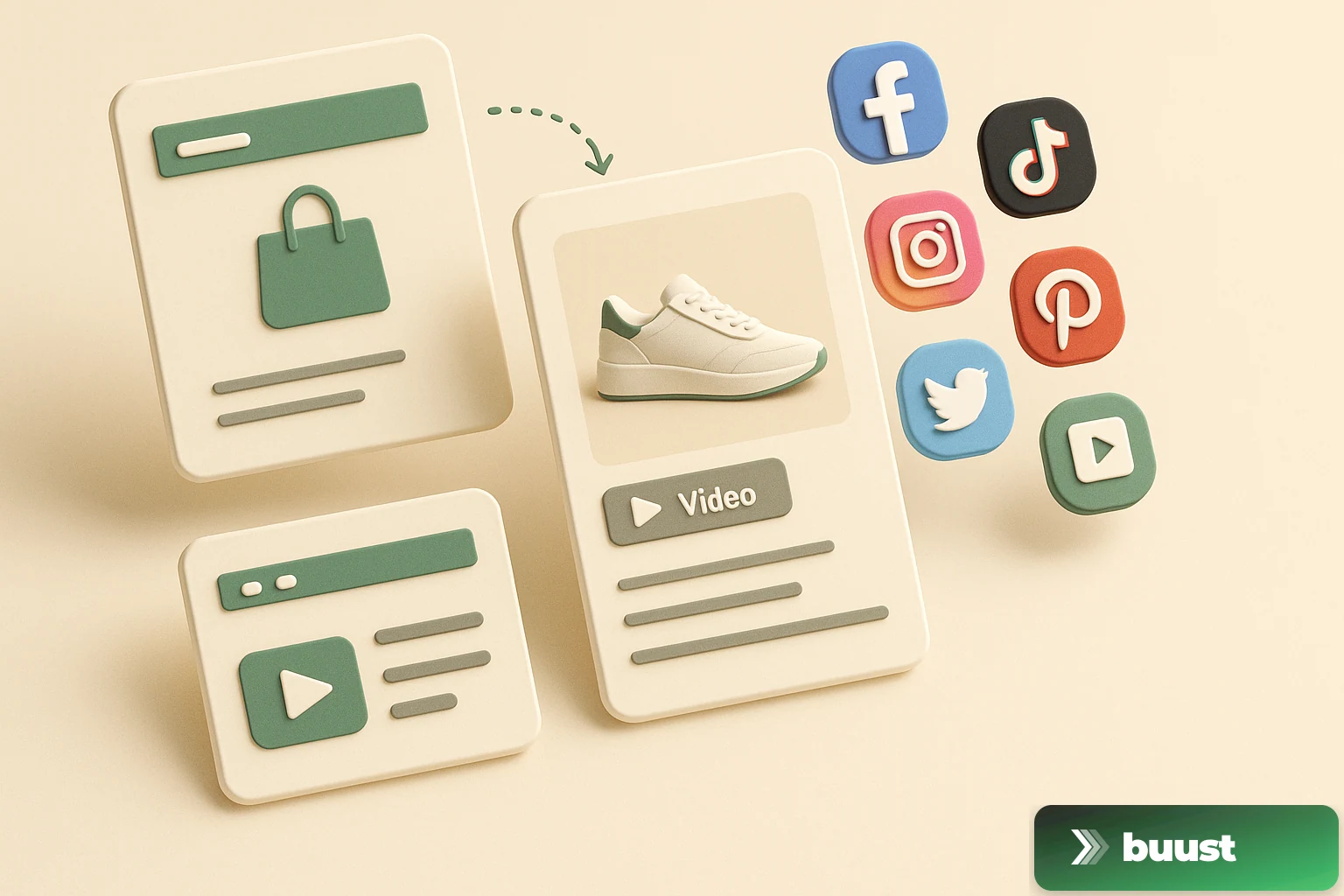
You connect your store, Buust pulls the products, generates videos, embeds them in your listings, and posts them to eight social channels. Here is the whole workflow at a glance — and why buyers decide differently with video.