OTTO Market: the underrated German marketplace with almost no video listings
OTTO Market has 17 million active buyers in Germany — and listings without video as far as the eye can see. Anyone bringing motion to their product pages now looks like an established brand among static competitors. Why DE brands shouldn't wait.


If you're a German online seller and you're not on OTTO Market in 2026, you're probably leaving revenue on the table. And if you are on OTTO but have no videos on your listings, you're leaving the single biggest lever the marketplace currently offers unused.
This isn't an exaggeration. A quick sample across any OTTO category shows it: most listings have five to ten photos and no video. Anyone embedding an 8-second Reel here looks instantly like an established brand among hobby sellers.
OTTO is not the boomer market some people think it is
There's a prejudice — especially from the D2C scene — that OTTO is a boomer mail-order house with catalog legacy. In 2010 that was half true. In 2026 it's wrong.
The OTTO Group has consistently rebuilt its marketplace as an open third-party model in recent years. Today, thousands of merchants sell their products there alongside OTTO's in-house assortment, app usage is on par with classic eCommerce apps, and buyer demographics have gotten younger — especially in home decor, fashion, and baby goods.
What still distinguishes OTTO:
- 17 million active customers in Germany — most of whom don't shop elsewhere when OTTO carries the product
- High loyalty through installments, invoice payments, and a very strong returns service
- Less buy-box madness compared to Amazon — listings compete less brutally on price
- Low to mid commissions in the DE marketplace comparison
Any German seller who only runs Amazon and Shopify is ignoring a buyer pool the size of three of the largest US marketplaces combined — one that also consumes in German, has German shipping expectations, and reads German trust signals.
What OTTO technically allows for video
OTTO has accepted videos on product listings for a while — the path is the partner integration, not manual upload masks. The key specs sellers should know:
- Format: MP4, typically H.264, mp4 container
- Resolution: minimum 720p, 1080p recommended, no benefit beyond 1080p
- Length: practical sweet spot between 6 and 25 seconds
- Audio track: recommended even when started muted
- Aspect ratio: square (1:1) and 16:9 both work, vertical renders inconsistently
On the product page, the video appears in the gallery between the photos. In some categories, a click on the first gallery element opens the video as auto-play in an enlarged viewer. On the mobile app, the video position is often more prominent than in the desktop browser.
Important to know: OTTO is asynchronous. Upload a video and you won't see it live in the same second — it runs through a processing pipeline that, depending on category, takes between a few minutes and several hours.
Why it matters now — not in twelve months
Every marketplace story shows the same pattern. A feature gets enabled. A handful of sellers use it. They harvest the early-mover advantage, collect reviews, conversions, algorithm boosts. Then the feature becomes table stakes. Then everyone competes.
Amazon videos were in that state around 2018. eBay videos around 2022. OTTO is there now.
Anyone listing videos on OTTO today benefits from:
- Visual differentiation in search results where 95 percent of the competition still shows pure photos
- Higher time-on-page on the product page, which positively influences OTTO's internal relevance signals
- Better conversion rate thanks to the trust anchor that the product is real and not just a render
- Algorithm boost, because OTTO tends to weight listings with video higher in internal sorting (informal reports from partner circles, not officially confirmed)
What sellers report from practice is consistent: conversion bumps of 15 to 40 percent at the product level once a video is added. The wide range comes down to product mix — for advisory-heavy products like furniture, tools, cosmetics, the lever is significantly bigger than for commodity items.
Which categories should move first
Not every product category benefits equally from video. If you sell on OTTO, prioritize:
- Furniture and home decor — room context matters, a static photo doesn't sell the mood
- Fashion and apparel — fabric drape and motion aren't visible in a photo
- Tools and DIY — buyers want to see function, not just material
- Kitchen appliances and household — usage beats description
- Baby and kids' products — safety and material quality feel more credible in video
In these categories, the conversion lever justifies the effort almost every time. In pure commodity categories (printer cartridges, screws, batteries), the ROI is lower — price decides there, not the video.
Where sellers stumble in practice
Three common stumbling blocks we see with German sellers approaching OTTO video:
- EAN requirement misunderstood: OTTO addresses products by EAN, not SKU. Sellers carrying products without EAN (often private label or vintage) can't list on OTTO at all — and therefore can't upload videos.
- Async pipeline underestimated: "Submitting" a video and seeing it live are two different things. Anyone who gets impatient and submits the video twice ends up blocking their own processing.
- Wrong specs: A video that looks perfect on Shopify (vertical, 9:16, sound-driven) renders ugly on OTTO. OTTO wants square or 16:9.
These three points alone explain why a lot of sellers "tried it once" and gave up. It's not the concept, it's the execution.
The pragmatic path to videos on OTTO
With Buust, you connect your OTTO account, pull your listings, pick a template — and the videos get generated in the correct OTTO specs and pushed into the pipeline. You don't have to build the EAN logic yourself, you don't have to babysit async processing, you don't have to click through per product.
Start for free and give your OTTO catalog motion before your competitors make the same move. The next twelve months are the early-mover advantage. After that, it's standard.
Common questions on the topic
How many active buyers does OTTO Market really have?+
The OTTO Group reports around 17 million active customers in Germany, with a growing share buying via the marketplace and not just the classic OTTO in-house assortment. For German buyers, OTTO is the second-largest generalist after Amazon — and ahead of eBay in many categories.
Does OTTO Market actually allow product videos?+
Yes. OTTO accepts MP4 videos per product via the partner interface. They appear in the product page gallery and, in some categories, directly in the main area. Acceptance rates are high as long as the specs are met.
How hard is it to get listed on OTTO Market as a new seller?+
Noticeably stricter than eBay, but more open than two years ago. OTTO manually vets every partner and requires EAN, a German address or EU representation, plus clean listing quality. The barrier is quality, not bureaucracy.
How much revenue can you realistically expect on OTTO?+
Strongly category-dependent. In fashion, furniture, home decor, and baby goods, partners report revenue that hits 30 to 60 percent of their Amazon volume — with significantly lower fees and less buy-box competition. In tech and generics, OTTO is weaker.
Ready to switch your listings to video?
10 videos free. No credit card. Connected in under 5 minutes.
Keep reading
Buust for your own shop: JTL, Shopware, Gambio, OXID, PrestaShop & more
Video tools almost always target Shopify. If you run a self-hosted shop, you watch from the sidelines. We're changing that: one plugin per system that writes the finished video straight into your product description — JTL, Shopware, Gambio, OXID, PrestaShop and more.
Does the video really work? How we measure revenue uplift honestly
Every vendor claims their tool lifts revenue. Almost none can prove it was the tool and not the season. We measure video uplift with difference-in-differences — and we'll also show you when nothing happened.
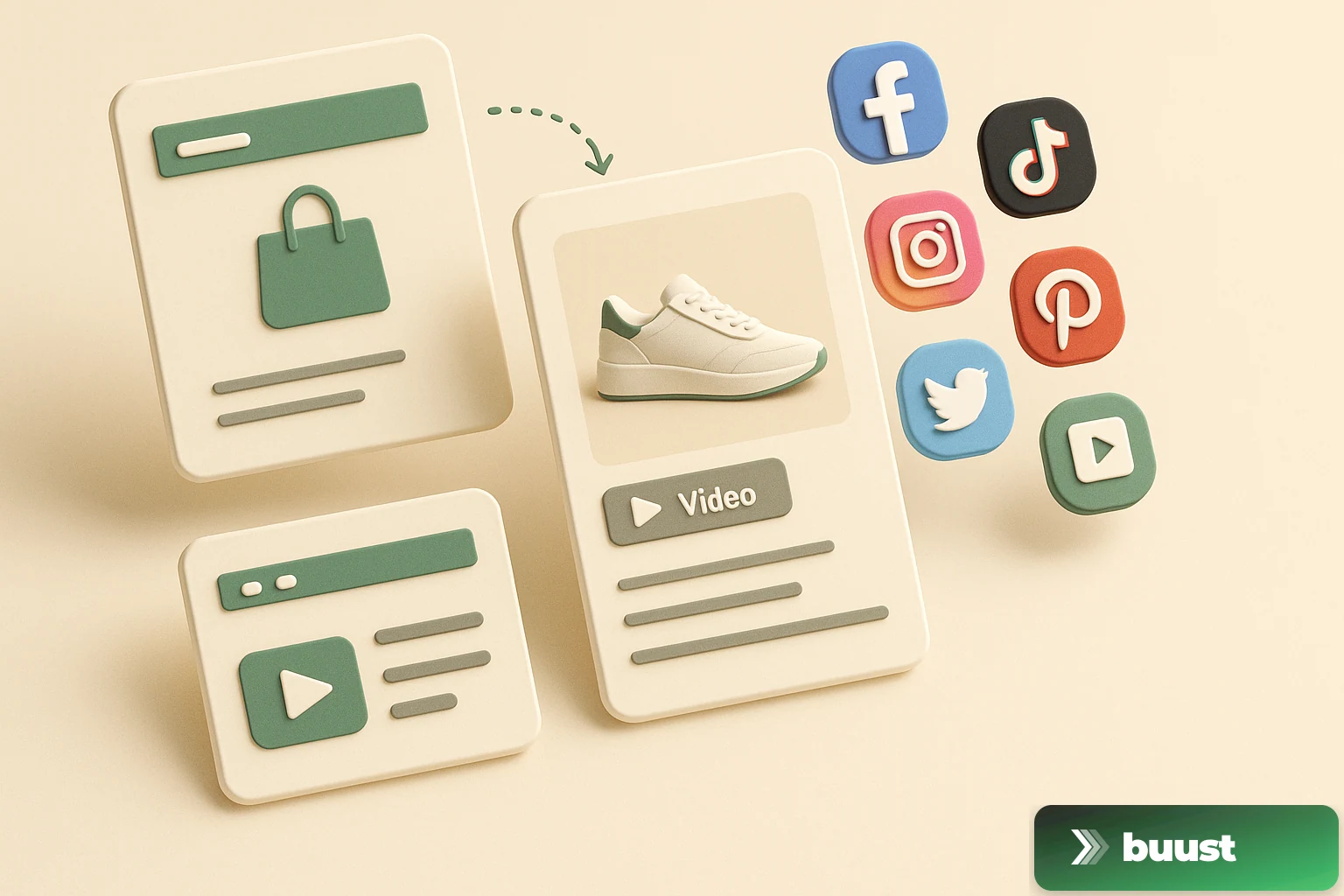
From Listing to Buyer: How Buust Brings One Product to 12 Channels
You connect your store, Buust pulls the products, generates videos, embeds them in your listings, and posts them to eight social channels. Here is the whole workflow at a glance — and why buyers decide differently with video.